

Tested Applications
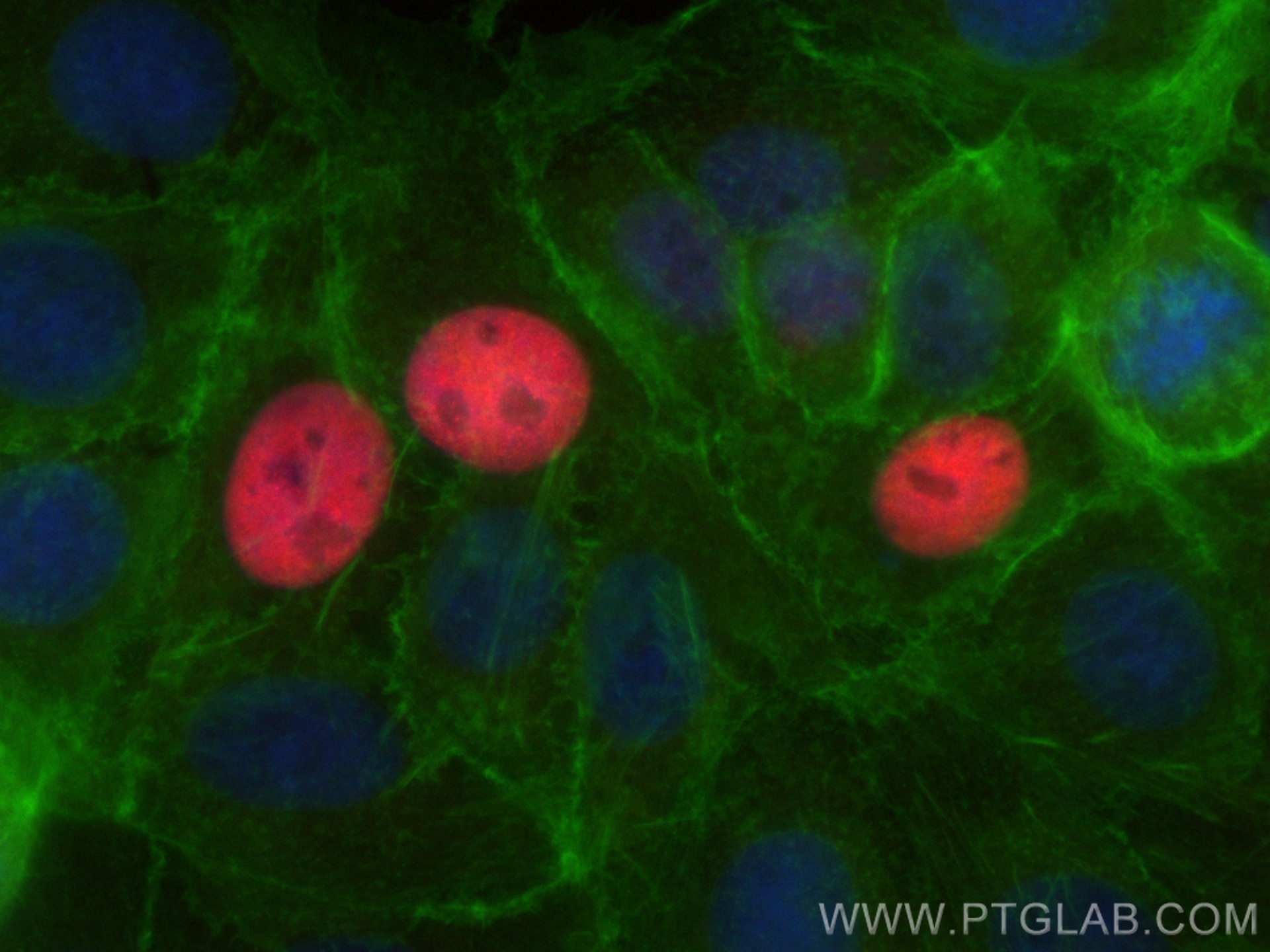
| Positive IF/ICC detected in | MCF-7 cells |
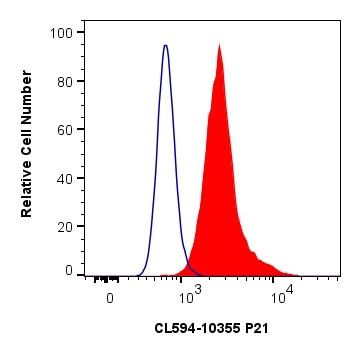
| Positive FC (Intra) detected in | MCF-7 cells |
Recommended dilution
| Application | Dilution |
|---|---|
| Immunofluorescence (IF)/ICC | IF/ICC : 1:50-1:500 |
| Flow Cytometry (FC) (INTRA) | FC (INTRA) : 0.80 ug per 10^6 cells in a 100 µl suspension |
| It is recommended that this reagent should be titrated in each testing system to obtain optimal results. | |
| Sample-dependent, Check data in validation data gallery. | |
Product Information
CL594-10355 targets P21 in IF/ICC, FC (Intra) applications and shows reactivity with human samples.
| Tested Reactivity | human |
| Host / Isotype | Rabbit / IgG |
| Class | Polyclonal |
| Type | Antibody |
| Immunogen |
CatNo: Ag0368 Product name: Recombinant human P21;CDKN1A protein Source: e coli.-derived, PGEX-4T Tag: GST Domain: 1-149 aa of BC000275 Sequence: MSEPAGDVRQNPCGSKACRRLFGPVDSEQLSRDCDALMAGCIQEARERWNFDFVTETPLEGDFAWERVRGLGLPKLYLPTGPRRGRDELGGGRRPGTSPALLQGTAEEDHVDLSLSCTLVPRSGEQAEGSPGGPGDSQGRKRRQTSMTD Predict reactive species |
| Full Name | cyclin-dependent kinase inhibitor 1A (p21, Cip1) |
| Calculated Molecular Weight | 18 kDa |
| Observed Molecular Weight | 21 kDa |
| GenBank Accession Number | BC000275 |
| Gene Symbol | p21 |
| Gene ID (NCBI) | 1026 |
| RRID | AB_2934700 |
| Conjugate | CoraLite®594 Fluorescent Dye |
| Excitation/Emission Maxima Wavelengths | 588 nm / 604 nm |
| Excitation Laser | Yellow-Green Laser (561 nm) |
| Form | Liquid |
| Purification Method | Antigen affinity purification |
| UNIPROT ID | P38936 |
| Storage Buffer | PBS with 50% glycerol, 0.05% Proclin300, 0.5% BSA, pH 7.3. |
| Storage Conditions | Store at -20°C. Avoid exposure to light. Stable for one year after shipment. Aliquoting is unnecessary for -20oC storage. |
Background Information
CDKN1A (p21, CIP1, WAF1) is a cyclin-dependent kinase inhibitor. CDKN1A binds to and inhibits the activity of cyclin-CDK2 or -CDK4 complexes, and thus functions as a regulator of cell cycle progression at the G1 phase. The expression of CDKN1A is induced by wild-type but not mutant p53 protein, through which CDKN1A mediates the p53-dependent cell cycle G1 phase arrest in response to a variety of stress stimuli. CDKN1A can interact with proliferating cell nuclear antigen (PCNA), and plays a regulatory role in S phase DNA replication and DNA damage repair. CDKN1A was reported to be specifically cleaved by CASP3-like caspases, which thus leads to a dramatic activation of CDK2, and may be instrumental in the execution of apoptosis following caspase activation. Two alternatively spliced variants, which encode an identical protein, have been reported.
Protocols
| Product Specific Protocols | |
|---|---|
| IF protocol for CL594 P21 antibody CL594-10355 | Download protocol |
| Standard Protocols | |
|---|---|
| Click here to view our Standard Protocols |
Publications
What published studies show
The P21 (CDKN1A) Polyclonal antibody, catalog number CL594-10355 (CoraLite® Plus 594 conjugate), has 1 indexed citation. It appears in bioRxiv (2025), in a study on AMPK signaling dysregulation in human tendinopathy and Achilles tendon dysfunction in mice. The associated research field is musculoskeletal biology / cell signaling (AMPK pathway), with the antibody applied in immunofluorescence (IF).
| Species | Application | Title |
|---|---|---|
bioRxiv AMPK signaling is dysregulated in human tendinopathy and loss of AMPKα1 leads to cell, matrix and mechanical dysfunction in mouse Achilles tendon |
Reviews
What customers say
One reviewer, Stefano Panella, rated this product 4 out of 5 stars. He used it for intracellular flow cytometry to detect senescence cells in iPS-derived cardiomyocytes at a 1:1000 dilution (Lot 21003354). The review was posted on May 6, 2026. Overall, the feedback is positive, confirming the antibody's utility in flow cytometry applications for senescence detection in specialized cell types.
The reviews below have been submitted by verified Proteintech customers who received an incentive for providing their feedback.
Stefano (Verified Customer) (05-06-2026) | Used for intracellular flow cytometry to detect senescence cells
|


