
Midbrain organoid generation: Practical tips from the bench
Written by: Jamuna Karanankattil Sukumaran, Senior Scientist at Protientech
Midbrain organoid generation: Practical tips from the bench
Human midbrain organoids have opened an entirely new window into studying dopaminergic neuron development, Parkinson’s disease mechanisms, and human-specific neurobiology. The landmark study by Jo et al., Cell Stem Cell 2016, provided the first robust road map for generating midbrain-like organoids (hMLOs) containing functional dopaminergic neurons and even neuromelanin.
But anyone who has worked with organoids knows:
A published protocol is only half the story.
Real success comes from the small adjustments, the timing, the feel of the culture, and the unspoken details you learn only by doing. This blog brings together science, practical steps, and the little things you only learn by doing, so you can grow healthy, well-structured midbrain organoids with confidence.
Note: All the growth factors used in our differentiation were from Proteintech and produced in HEK293 cells, ensuring they are human-derived. This is particularly important for midbrain organoid development, as these proteins carry native human post-translational modifications that directly influence stability, receptor binding, and downstream signaling strength. By using HEK-expressed human growth factors, the cues delivered to the organoids more closely replicate true human biology, resulting in more reproducible FOXA2 induction, improved neuroepithelial organization, and more reliable dopaminergic maturation.
Organoids were embedded in VitroGel® STEM (TheWell Bioscience, SKU: VHM02), a xeno-free, tunable hydrogel optimized for 3D stem cell culture.
1. Start with high-quality pluripotent stem cells
The quality of pluripotent stem cells is fundamental to organoid development. Using low-passage hESCs (below passage 40) remains essential for achieving consistent results.
Key features to consider include:
-
Uniform colony morphology
-
Minimal spontaneous differentiation
-
Mycoplasma-free cultures
-
Stable pluripotency markers (OCT4, NANOG, SOX2, SSEA-4, TRA-1-60, and TRA-1-81, etc.)
-
If the starting culture is heterogeneous, FOXA2 induction, neuroepithelial structure, and overall patterning efficiency will all be significantly compromised.
2. Generate consistent embryoid bodies
Uniformity at the EB stage directly affects downstream patterning. Consistent EBs can be generated by seeding the same number of cells into ultra–low-attachment U- or V-bottom wells.
Key features to consider include:
-
2500–3000 cells/well gives optimal EB size (~400 µm)
-
Use ROCK inhibitor (10 µM) for the first 24 hours
-
EBs should be compact and spherical
-
Avoid overgrowth. Larger EBs are prone to necrosis
The uniform size of EBs enables homogeneous diffusion of growth factors during early patterning.
3. Precisely control early patterning: Dual-SMAD Inhibition + CHIR
During days 0–4, the combined treatment with Noggin, SB431542, and CHIR99021 promotes neuroectoderm specification while driving Wnt-mediated midbrain induction.
Key consideration:
-
CHIR concentration dictates rostro caudal identity
Low concentrations of CHIR induce anterior or rostral fates, such as the forebrain and midbrain. Increasing concentrations of CHIR promote progressively more posterior or caudal fates, including the hindbrain and spinal cord.
Most labs find that 0.7–1.0 µM CHIR works well, but this must be optimized per cell line due to Wnt-sensitivity differences. When FOXA2 or OTX2 expressions are poor, CHIR is usually the parameter that needs adjustment.
4. Midbrain fate specification requires active SHH and FGF8
From days 4–7, the addition of SHH and FGF8 is the key step which patterns the EBs towards mesencephalic fate. This phase should ideally produce:
-
FOXA2+ floor plate progenitors
-
OTX2+ midbrain progenitors
-
Early LMX1A, CORIN expression
Key features to consider include:
-
SHH is highly sensitive to freeze–thaw cycles; use small aliquots
-
Even minor reductions in SHH activity reduce FOXA2 induction
-
Longer exposure (3–4 days) improves floor plate uniformity
Correct patterning here determines the emergence of TH+ cells.
5. Embed at the correct timing to support 3D architecture
Day 7 is the transition to 3D morphogenesis, when neuroectodermal buds begin forming.
Embedding the EB in geltrex/vitrogel:
-
Promotes neuroepithelial expansion
-
Supports apical–basal polarity
-
Facilitates VZ–IZ–MZ organization
Important tips:
-
If using geltrex, work on ice to prevent premature polymerization
-
Embedding too early or too late disrupts tissue layering
6. Use orbital shaker culture to improve oxygenation and growth
After embedding, organoids are transferred to ultra-low-attachment plates and cultured on an orbital shaker (65–85 rpm).
Shaking dramatically improves:
-
Nutrient distribution
-
Gas exchange
-
Neuroepithelial folding
-
Prevention of organoid fusion
This is particularly important for dopaminergic neuron survival, as these cells are metabolically active and sensitive to hypoxia.
7. Support dopaminergic maturation with neurotrophic factors
From this stage onwards (Day 8), the organoids receive BDNF, GDNF, Ascorbic acid, and cAMP (db-cAMP).
These factors:
-
Promote TH+ dopaminergic neuron survival
-
Enhance neurite outgrowth
-
Support dopamine synthesis
-
Improve synaptic maturation
Ascorbic acid must be added fresh. Oxidized Ascorbic acid compromises DA neuron maturation and TH expression.
Table 1: Troubleshooting
|
Issue |
Possible reason |
Fix |
|
Weak FOXA2 |
Low SHH activity |
Use fresh aliquots |
|
Excess forebrain markers |
CHIR too low |
Increase CHIR by 0.2–0.3 µM |
|
Organoid fusion |
Low agitation speed |
Increase shaker speed to ~80 rpm |
|
Central necrosis |
Diffusion limits |
More frequent media changes |
|
Weak TH expression |
Poor DA maturation |
Fresh Ascorbic acid, extend culture time |
Table 2: Recombinant human growth factors used
|
Growth Factor |
Product Name |
|
Catalog Number |
|
|
Noggin |
HumanKine® recombinant human Noggin |
|
HZ-1118 |
|
|
Sonic Hedgehog (SHH) |
HumanKine® recombinant human SHH |
|
HZ-1306 |
|
|
FGF-8b |
HumanKine® recombinant human FGF-8b |
|
HZ-1103 |
|
|
GDNF |
HumanKine® recombinant human GDNF |
|
HZ-1311 |
|
|
BDNF |
HumanKine® recombinant human BDNF |
|
HZ-1335 |
|
Table 3: Antibodies used
|
Antibody Name |
Catalog Number |
|
FOXA2 Polyclonal antibody |
22474-1-AP |
|
Nestin Polyclonal antibody |
19483-1-AP |
|
SOX2 Monoclonal antibody |
66411-1-Ig |
|
MAP2 Monoclonal antibody |
67015-1-Ig |
|
Ki-67 Polyclonal antibody |
27309-1-AP |
|
OTX2 Polyclonal antibody |
13497-1-AP |
|
Nurr1 Polyclonal antibody |
10975-2-AP |
|
ASCL1 (MASH1) Polyclonal antibody |
31206-1-AP |
|
TH Polyclonal antibody |
25859-1-AP |
|
Dopamine Transporter (DAT) Polyclonal antibody |
22524-1-AP |
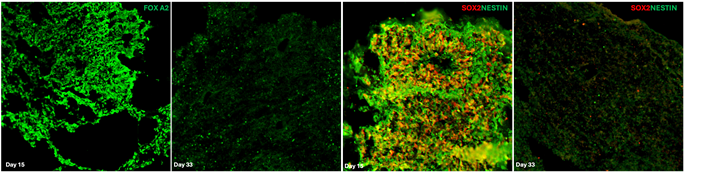
Figure 1: IF staining of FOXA2 on Day 15 (A), Day 33 (B); NESTIN SOX2 on Day 15 (C) and Day 33 (D) of midbrain organoid differentiation. 20X magnification 10um section.

Figure 2: IF staining of MAP2 Ki67 on Day 15 (A) and Day 33 (B) of midbrain organoid differentiation. 20X magnification, 10um section.
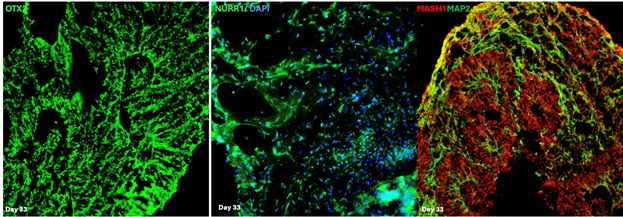
Figure 3. IF staining of OTX2 (A), NURRI (B), and MASHI MAP2 (C) on day 33 of midbrain organoid differentiation.
 |
 |
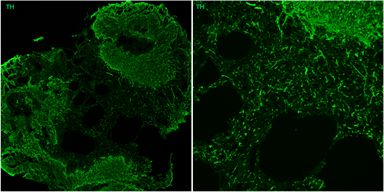
Figure 4. IF staining of TH on Day 33, 4X magnification (A), Day 33, 10X magnification (B); DAT on Day 33, 10X magnification (C) and Day 33, 20X magnification (D). Section size -25um
Related Content
The power of neutrophils: How to identify the immune system’s first responders | Proteintech Group
Guide to Flow Cytometry Panel Building | Proteintech Group
Flow Cytometry Gating for Beginners | Proteintech Group
Hematopoietic Stem and Progenitor Cells (HSPCs): What They Are and How to Identify Them | Proteinte…
Support
Newsletter Signup
Stay up-to-date with our latest news and events. New to Proteintech? Get 10% off your first order when you sign up.