
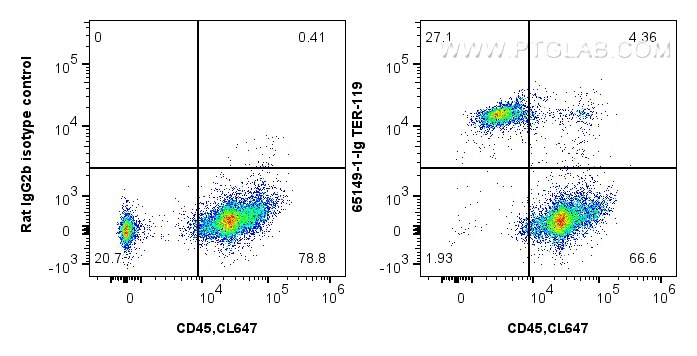

Tested Applications
| Positive FC detected in | mouse bone marrow cells |
Recommended dilution
| Application | Dilution |
|---|---|
| Flow Cytometry (FC) | FC : 0.5 ug per 10^6 cells in 100 ul suspension |
| This reagent has been tested for flow cytometric analysis. It is recommended that this reagent should be titrated in each testing system to obtain optimal results. | |
| Sample-dependent, Check data in validation data gallery. | |
Product Information
65149-1-Ig targets TER-119 in IF, FC applications and shows reactivity with Mouse samples.
| Tested Reactivity | Mouse |
| Cited Reactivity | mouse |
| Host / Isotype | Rat / IgG2b, kappa |
| Class | Monoclonal |
| Type | Antibody |
| Immunogen |
Day-14 fetal liver cells from a C57BL/6 mouse Predict reactive species |
| Full Name | lymphocyte antigen 76 |
| Gene Symbol | TER-119 |
| Gene ID (NCBI) | 104231 |
| RRID | AB_2918434 |
| Conjugate | Unconjugated |
| Form | Liquid |
| Purification Method | Affinity purification |
| Storage Buffer | PBS with 0.09% sodium azide, pH 7.3. |
| Storage Conditions | Store at 2-8°C. Stable for one year after shipment. |
Background Information
TER-119 is a mouse erythroid lineage-specific monoclonal antibody that reacts with erythroid cells at differentiation stages from early proerythroblast to mature erythrocyte, but not with cells showing typical erythroid blast-forming unit (BFU-E) and erythroid colony-forming unit (CFU-E) activities (PMID: 1975515; 10848813). TER-119 recognizes a 52-kDa molecule on erythrocyte membranes (PMID: 10848813). TER-119 antigen is a molecule associated with cell-surface glycophorin A but not with glycophorin A itself (PMID: 10848813).
Protocols
| Product Specific Protocols | |
|---|---|
| FC protocol for TER-119 antibody 65149-1-Ig | Download protocol |
| Standard Protocols | |
|---|---|
| Click here to view our Standard Protocols |
Publications
What published studies show
I'll search for citations for catalog 65149-1-Ig.Anti-Mouse TER-119 (TER-119), catalog number 65149-1-Ig, has a total of 2 citations. The citations appear in the journals Advanced Science (Weinheim) (used in research on engineered extracellular vesicles for ameliorating bacterial sepsis) and Thrombosis and Haemostasis (used in IF staining to study platelet-derived TGF-β1 in deep vein thrombosis). Associated research fields include sepsis/inflammation and thrombosis/vascular biology.
| Species | Application | Title |
|---|---|---|
Adv Sci (Weinh) Engineered Extracellular Vesicles Driven by Erythrocytes Ameliorate Bacterial Sepsis by Iron Recycling, Toxin Clearing and Inflammation Regulation | ||

