
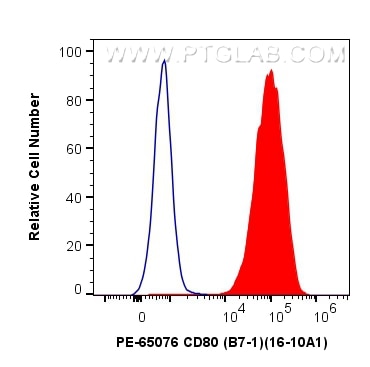

Tested Applications
| Positive FC detected in | mouse peritoneal macrophages |
Recommended dilution
| Application | Dilution |
|---|---|
| Flow Cytometry (FC) | FC : 0.5 ug per 10^6 cells in 100 μl suspension |
| This reagent has been tested for flow cytometric analysis. It is recommended that this reagent should be titrated in each testing system to obtain optimal results. | |
| Sample-dependent, Check data in validation data gallery. | |
Product Information
PE-65076 targets CD80 in IF, FC applications and shows reactivity with mouse samples.
| Tested Reactivity | mouse |
| Cited Reactivity | mouse |
| Host / Isotype | Armenian Hamster / IgG |
| Class | Monoclonal |
| Type | Antibody |
| Immunogen |
CHO cell line transfected with mouse B7 (CD80) Predict reactive species |
| Full Name | CD80 antigen |
| GenBank Accession Number | BC131959 |
| Gene Symbol | CD80 |
| Gene ID (NCBI) | 12519 |
| RRID | AB_2883872 |
| Conjugate | PE Fluorescent Dye |
| Excitation/Emission Maxima Wavelengths | 496 nm, 565 nm / 578 nm |
| Excitation Laser | Blue Laser (488 nm), Green Laser (532 nm), Yellow-Green Laser (561 nm) |
| Form | Liquid |
| Purification Method | Affinity purification |
| UNIPROT ID | Q00609 |
| Storage Buffer | PBS with 0.09% sodium azide and 0.5% BSA, pH 7.3. |
| Storage Conditions | Store at 2-8°C. Avoid exposure to light. Stable for one year after shipment. |
Background Information
CD80 (also known as B7-1) is a type I membrane protein that is a member of the immunoglobulin superfamily, with an extracellular immunoglobulin constant-like domain and a variable-like domain required for receptor binding. It is expressed on antigen-presenting cells (APCs), including B cells, dendritic cells, monocytes, and macrophages. CD80 is the receptor for the proteins CD28 and CTLA-4 found on the surface of T-cells. It is involved in the costimulatory signal essential for T-lymphocyte activation. T-cell proliferation and cytokine production is induced by the binding of CD28, binding to CTLA-4 has opposite effects and inhibits T-cell activation. CD80 also acts as a cellular attachment receptor for adenovirus subgroup B. (PMID: 7545666; 12015893; 16920215)
Protocols
| Product Specific Protocols | |
|---|---|
| FC protocol for PE CD80 antibody PE-65076 | Download protocol |
| Standard Protocols | |
|---|---|
| Click here to view our Standard Protocols |
Publications
What published studies show
PE-65076 is Anti-Mouse CD80 (16-10A1), a PE-conjugated monoclonal antibody with 18 indexed citations. These appear in high-impact journals including Advanced Materials, Advanced Science, Cell Reports Medicine, Bioactive Materials, Small, and Analytical Chemistry. Research fields span cancer immunotherapy (melanoma, breast cancer), nanomedicine and drug delivery, infectious disease and wound healing, vaccine development, osteoarthritis, allergy, and inflammatory bowel disease. The antibody was primarily used in flow cytometry for mouse models.
| Species | Application | Title |
|---|---|---|
Adv Mater Synchronous Sterilization and Immunoreaction Termination for Corneal Transparency Protection in Treating Pseudomonas aeruginosa Induced Bacterial Keratitis | ||
Adv Mater Engineering a Lipid Nanoparticle with Atypical Calcium Crystal Structure for Enhanced IFNβ-Mediated Immunotherapy | ||
Bioact Mater Turning foes to friends: Advanced "in situ nanovaccine" with dual immunoregulation for enhanced immunotherapy of metastatic triple-negative breast cancer | ||
J Adv Res Design of a targeted dual drug delivery system for boosting the efficacy of photoimmunotherapy against melanoma proliferation and metastasis | ||
Acta Pharm Sin B Novel Pt(IV) complex OAP2 induces STING activation and pyroptosis via mitochondrial membrane remodeling for synergistic chemo-immunotherapy | ||
Adv Sci (Weinh) A Porphyrin Nanomaterial for Photoimmunotherapy for Treatment of Melanoma |

