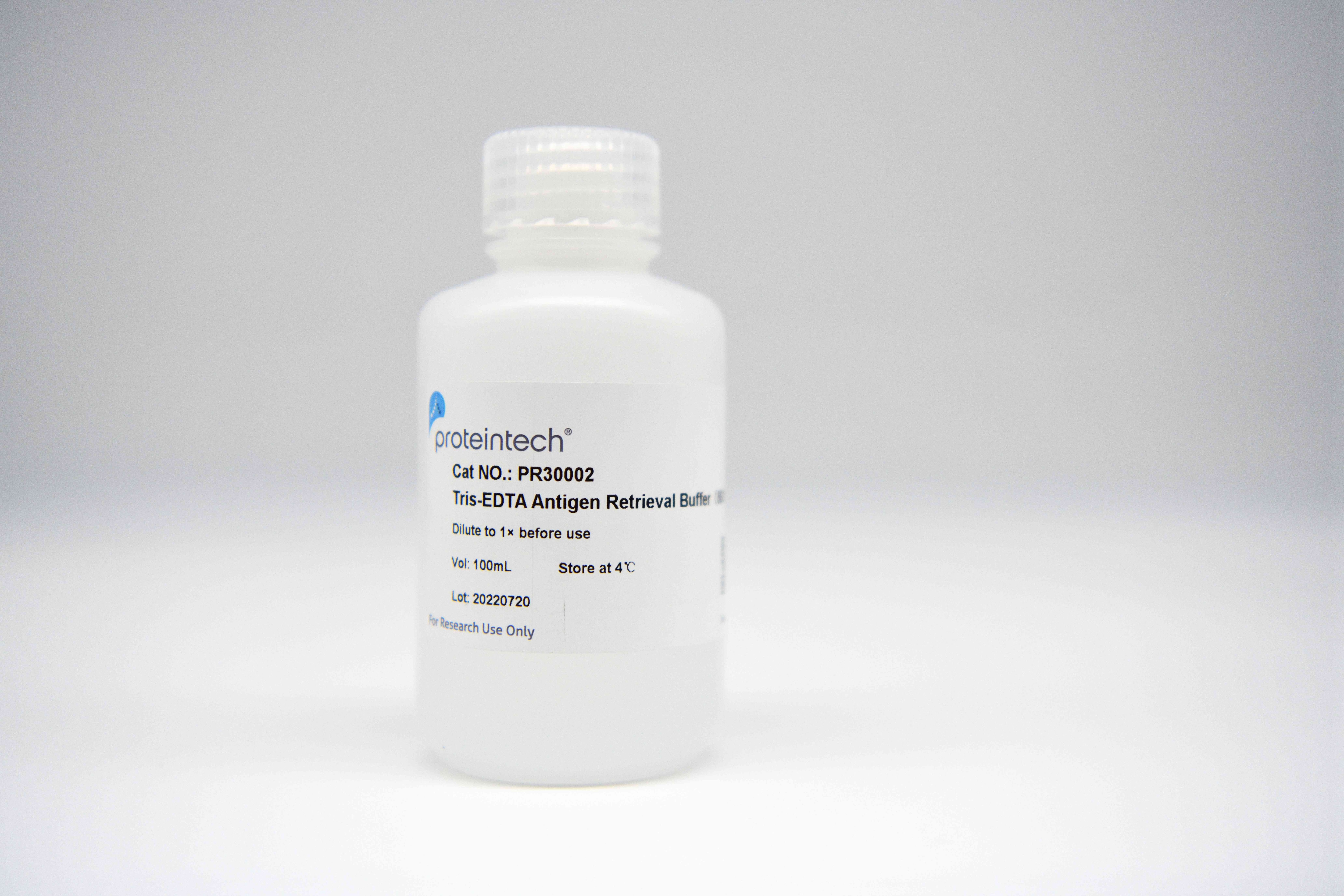

Product Information
PR30002 is a Tris-EDTA based solution that can be used for performing heat-induced epitope retrieval (HIER) in immunohistochemistry applications. While treating tissues with formalin and xylene are necessary steps for fixation and deparaffinization in an immunohistochemistry workflow, such treatments often result in protein cross-linking leading to the masking of antigenic sites and the subsequent inhibition of antigen-antibody interactions. Antigen retrieval helps restore the structure of such proteins by breaking the cross-links and unmasking the antigenic sites, thereby making them more accessible to antibodies.
Components
| Component | Size |
| Retrieval Buffer | 100 mL |
Storage
Stored at 2-8°C. This product is stable for 6 months from the date of receipt.
Usage
1. Prepare slides from tissues sections following routine methods. Deparaffinize tissues with xylene and re-hydrate using a decreasing ethanol gradient.
2. Use concentrated PR30002 (Tris-EDTA Antigen Retrieval Buffer 50x) to prepare a solution by adding the concentrated buffer to ddH2O. For example, to make 500 mL of 1x working solution, dilute 10 mL PR30002 with 490 mL ddH2O.
* 500 mL of prepared 1x antigen retrieval buffer in a 1 L beaker should be suitable for 1 or 2 slide baskets.
3. Heat buffer solution to 95-98°C with a heating element.
* Cover the beaker with a lid or foil to avoid vaporizing/vapor inhalation.
4. Place slide basket into heated antigen retrieval buffer. Maintain this temperature while incubating for 15-20 minutes.
5. Remove the beaker from heat and let it cool to room temperature (takes 35-40 minutes).
6. Perform subsequent steps of quenching, blocking, primary and secondary antibody incubation, signal development, counter staining and mounting before analyzing the slides.
Application Note
1. Dilute to 1x before use.
2. Calculate how much antigen retrieval buffer will be needed for the experiment to prepare an appropriate amount of 1x working solution. The working solution has a shorter shelf life than the concentrate.
Cited in Article as
PR30002, Tris-EDTA Antigen Retrieval Buffer (50X), Proteintech, IL, USA
Documentation
| SDS |
|---|
| Tris-EDTA Antigen Retrieval Buffer (50X) Datasheet |
| Datasheet |
|---|
| Tris-EDTA Antigen Retrieval Buffer (50X) Datasheet |
Publications
| Application | Title |
|---|---|
Mol Cancer Deubiquitination of CDC6 by OTUD6A promotes tumour progression and chemoresistance | |
Cell Host Microbe A meta-analysis of the gut microbiome in inflammatory bowel disease patients identifies disease-associated small molecules | |
Cancer Res Spatial and Single-Cell Transcriptomics Reveal a Cancer-Associated Fibroblast Subset in HNSCC That Restricts Infiltration and Antitumor Activity of CD8+ T Cells | |
Nat Commun In situ osteogenic activation of mesenchymal stem cells by the blood clot biomimetic mechanical microenvironment | |
J Exp Clin Cancer Res SPP1+ macrophages promote head and neck squamous cell carcinoma progression by secreting TNF-α and IL-1β | |
Adv Sci (Weinh) Hepatocyte PIEZO1 Negatively Regulates Lipogenesis and Ameliorates MASLD by Sensing Membrane Tension and Activating AMPK. |
Reviews
The reviews below have been submitted by verified Proteintech customers who received an incentive for providing their feedback.
FH Alicia (Verified Customer) (10-16-2025) | It works well for proteins hard to detect
|
FH Hariam (Verified Customer) (12-06-2024) | We used the Tris-EDTA AG retrieval buffer before staining of brain organoid slides. Works great for harder to detect targets. The product was used on cryosections for 20 minutes at 95 degrees Celsius. Signal was improved significantly Highly recommended.
|