

Tested Applications
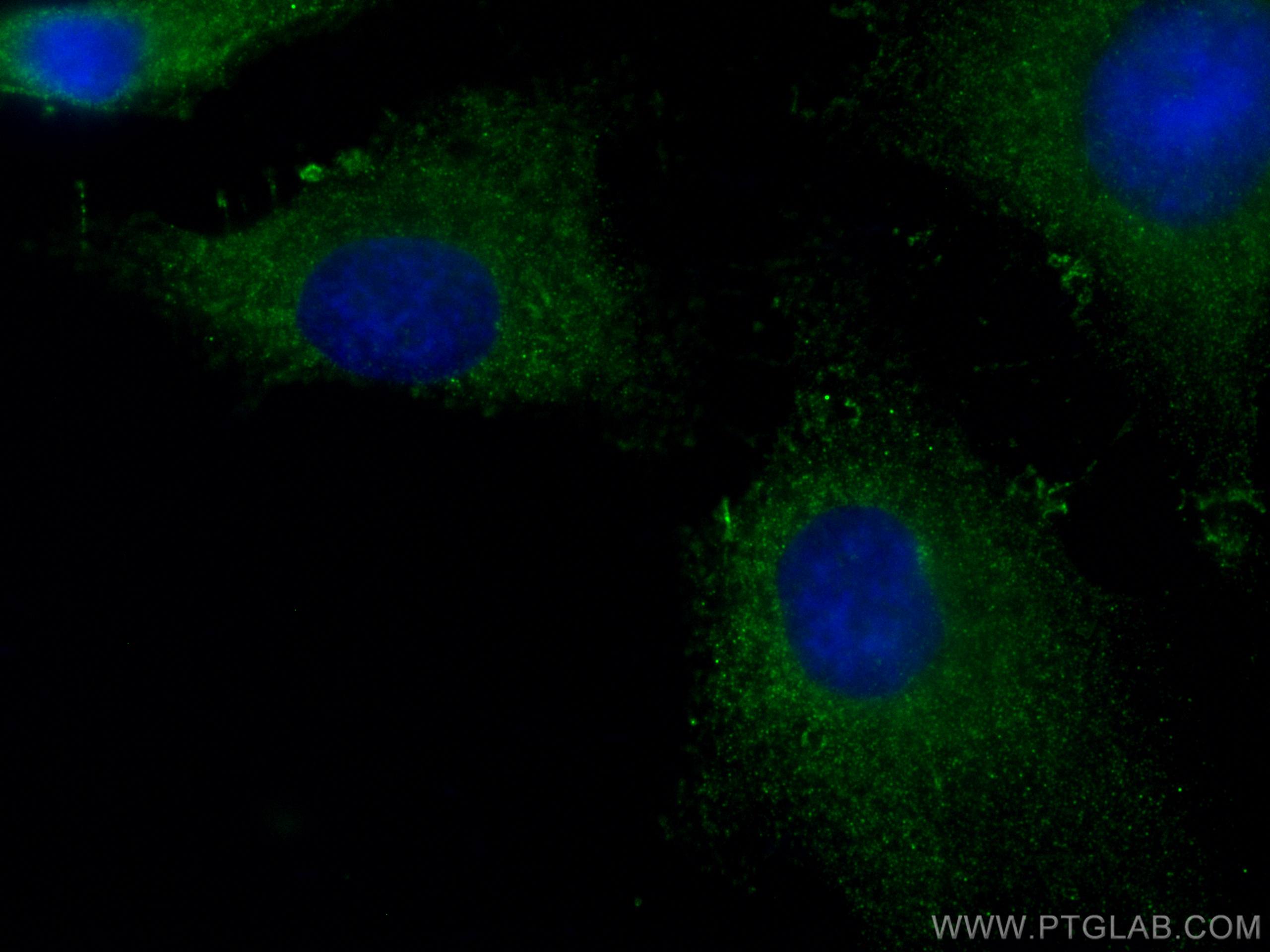
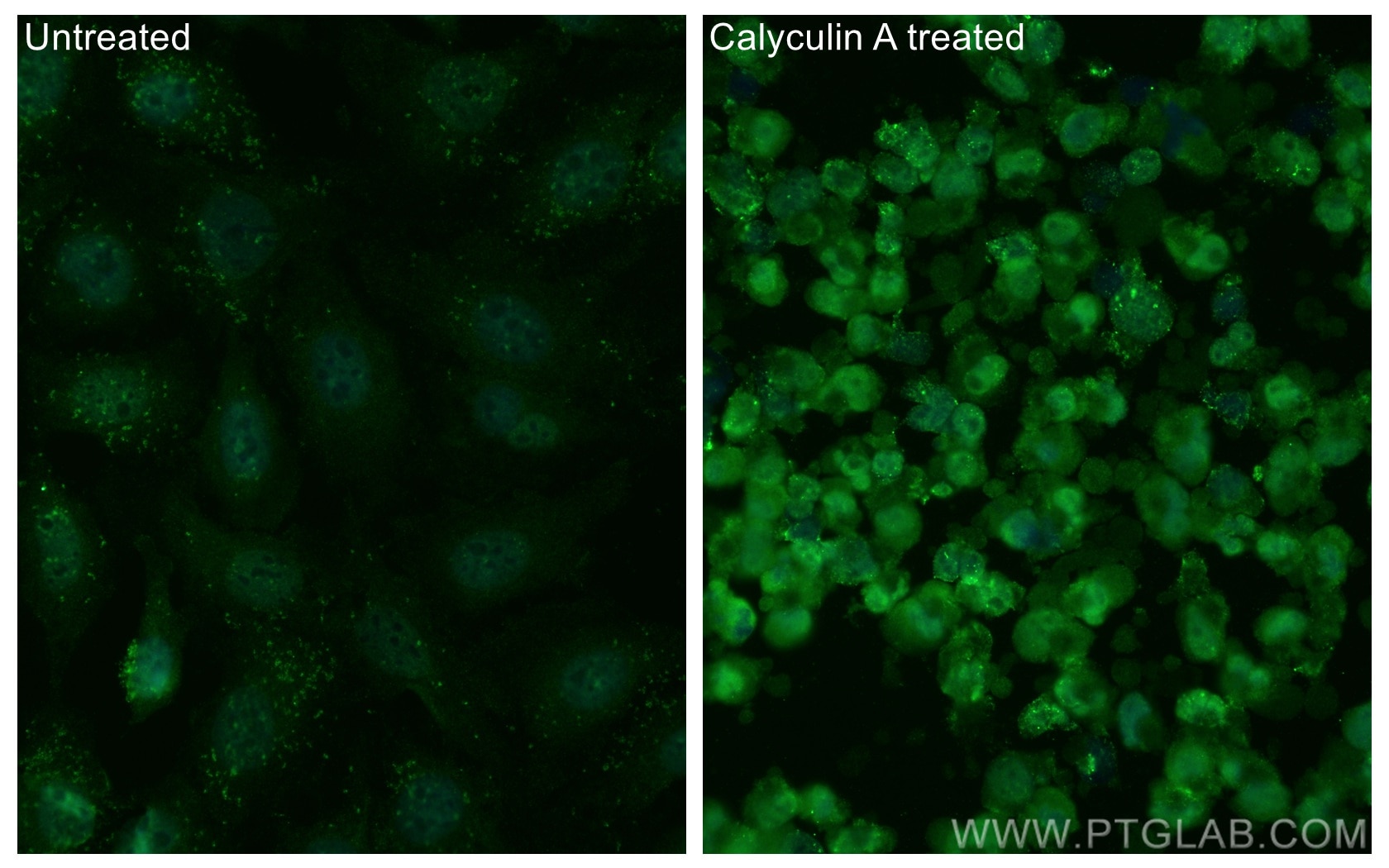
| Positive IF/ICC detected in | HeLa cells, Calyculin A treated HeLa cells |
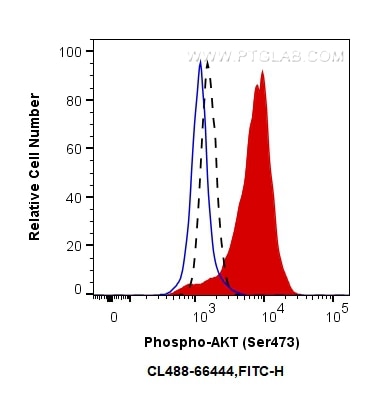
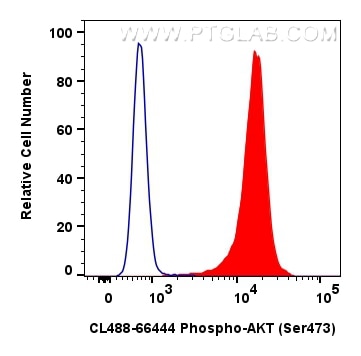
| Positive FC (Intra) detected in | Calyculin A treated PC-3 cells, Calyculin A treated HEK-293T cells |
Recommended dilution
| Application | Dilution |
|---|---|
| Immunofluorescence (IF)/ICC | IF/ICC : 1:50-1:500 |
| Flow Cytometry (FC) (INTRA) | FC (INTRA) : 0.25 ug per 10^6 cells in a 100 µl suspension |
| It is recommended that this reagent should be titrated in each testing system to obtain optimal results. | |
| Sample-dependent, Check data in validation data gallery. | |
Product Information
CL488-66444 targets Phospho-AKT (Ser473) in WB, IF/ICC, FC (Intra) applications and shows reactivity with human, mouse samples.
| Tested Reactivity | human, mouse |
| Cited Reactivity | human |
| Host / Isotype | Mouse / IgG1 |
| Class | Monoclonal |
| Type | Antibody |
| Immunogen |
Peptide Predict reactive species |
| Full Name | v-akt murine thymoma viral oncogene homolog 1 |
| Observed Molecular Weight | 60-62 kDa |
| GenBank Accession Number | NM_005163 |
| Gene Symbol | AKT1 |
| Gene ID (NCBI) | 207 |
| RRID | AB_2919327 |
| Conjugate | CoraLite® Plus 488 Fluorescent Dye |
| Excitation/Emission Maxima Wavelengths | 493 nm / 522 nm |
| Excitation Laser | Blue laser (488 nm) |
| Form | Liquid |
| Purification Method | Protein A purification |
| UNIPROT ID | P31749 |
| Storage Buffer | PBS with 50% glycerol, 0.05% Proclin300, 0.5% BSA, pH 7.3. |
| Storage Conditions | Store at -20°C. Avoid exposure to light. Stable for one year after shipment. Aliquoting is unnecessary for -20oC storage. |
Background Information
1) What is AKT?
The serine/threonine kinase B AKT pathway (also known as the PI3K-Akt pathway) plays a vital role in the regulation of cellular processes, including cell proliferation, survival, and growth - processes that are essential for oncogenesis. Mutation of the regulator proteins PI3K and PTEN causes uncontrolled disruption within the PI3-kinase pathway, leading to the development of human cancers (1,2; see also AKT pathway poster for more details).
2) phospho-AKT and FAQs
A) What is the best way to normalize phosphorylated proteins analyzed by western blot?
Normalize phospho-AKT and total AKT with your loading control (e.g. Actin, tubulin), then calculate the phospho/total ratio using these normalized values.
Put more simply:
1. Calculate the ratio of band intensities of a phospho-AKT band: the loading control.
2. Calculate the ratio of band intensities of total AKT: loading control.
3. Divide ratio obtained #1 by #2 to obtain a normalized value for comparison among different conditions. This procedure allows one to distinguish between a change in AKT expression and a change in the ratio of phospho-AKT.
* If you are looking at the differences in a phospho-AKT expression resulting from an experimental condition (e.g., knockdown), you should also show the expression of total AKT to distinguish between a change in AKT expression (transcription/translation level) and a change in the AKT phosphorylation status.
B) What is the observed molecular weight for AKT and phospho-AKT?
Molecular Weight AKT - 56 kDa
Molecular Weight phospho-AKT - 60 kDa (Figure 1)

Figure 1. WB: HEK-293 cell lysate was subjected to SDS PAGE followed by western blot with 60203-2-Ig (AKT antibody) and 66444-1-Ig (AKT-phospho-S473 antibody) at a dilution of 1:4000 incubated at room temperature for 1.5 hours.
C) Are there any special WB conditions to optimize staining of a phospho-AKT?
Since this is a phosphorylated protein, 5% BSA is recommended over non-fat milk as a blocking agent.
D) What are good positive and negative controls for a phospho-AKT?
- Positive Control: HEK293 cells
- Negative Control: Treatment with PI3K inhibitors (e.g. wortmannin)
E) What species does this antibody react with?
Our internal testing has confirmed that it reacts with the human and mouse forms of phospho-AKT.Reactivity with the human form is also supported by the literature's citations of this antibody.
References:
1. Perturbations of the AKT signaling pathway in human cancer.
2. Targeting the PI3K-Akt pathway in human cancer: rationale and promise.
Protocols
| Product Specific Protocols | |
|---|---|
| IF protocol for CL Plus 488 Phospho-AKT (Ser473) antibody CL488-66444 | Download protocol |
| Standard Protocols | |
|---|---|
| Click here to view our Standard Protocols |
Publications
What published studies show
CL488-66444 is the CoraLite® Plus 488-conjugated form of Phospho-AKT (Ser473) Monoclonal antibody (1C10B8). It has 2 citations, appearing in Journal of Translational Medicine and International Journal of Biological Macromolecules. The associated research fields include cervical cancer cell migration/invasion and psoriasis relief via polysaccharide treatment, both studied by Western blot in human samples.
| Species | Application | Title |
|---|---|---|
J Transl Med Targeting cell membrane sphingolipids: a novel ceramide analog CeY-B1 inhibits migration and invasion in cervical cancer cells. | ||
Int J Biol Macromol An inulin-type polysaccharide from Atractylodis Macrocephalae Rhizoma can relieve psoriasis |
Reviews
What customers say
One customer review was found for this product. Pierre D. used CL488-66444 (lot 21009281) on T cells for immunofluorescence and rated it 3 out of 5 stars, noting that the signal was weak. The review was posted in September 2025. No additional images, dilution details, or further comments were provided.
The reviews below have been submitted by verified Proteintech customers who received an incentive for providing their feedback.
Pierre (Verified Customer) (09-25-2025) | Signal weak
|


