
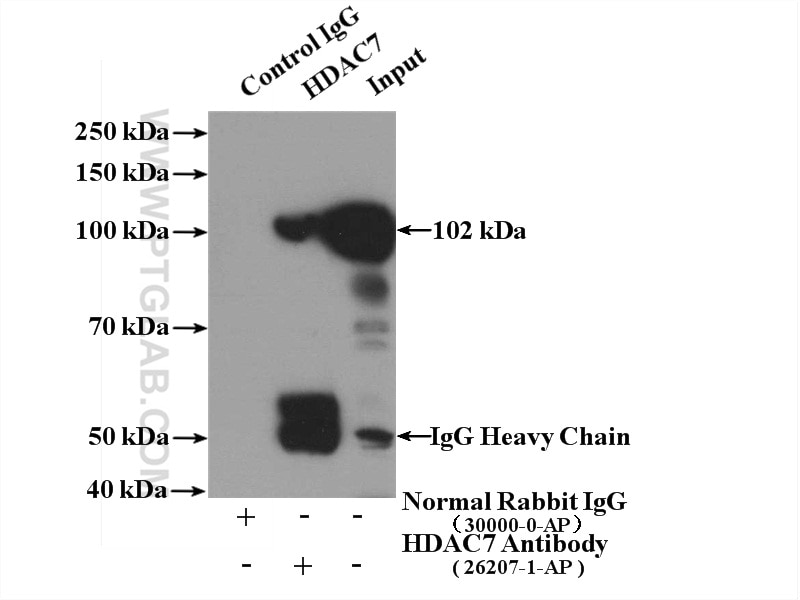
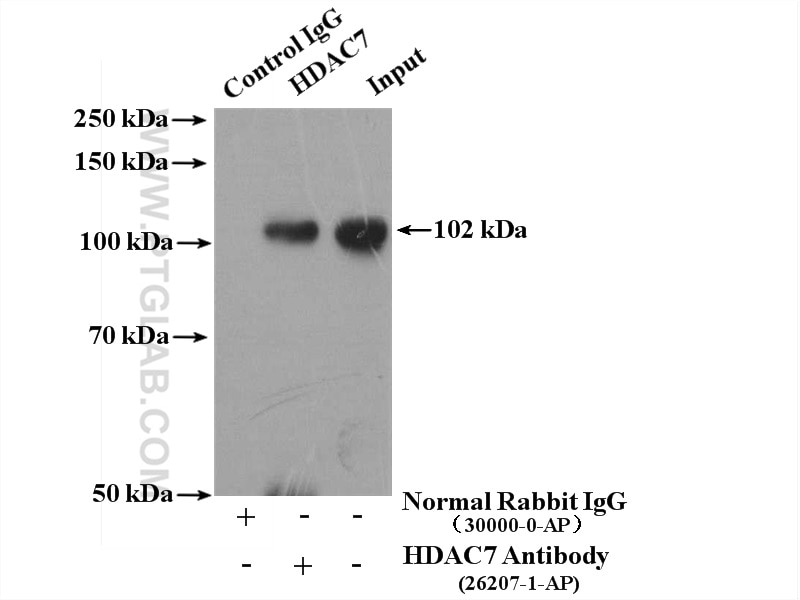

Tested Applications
| Positive IP detected in | K-562 cells |
Recommended dilution
| Application | Dilution |
|---|---|
| Immunoprecipitation (IP) | IP : 0.5-4.0 ug for 1.0-3.0 mg of total protein lysate |
| It is recommended that this reagent should be titrated in each testing system to obtain optimal results. | |
| Sample-dependent, Check data in validation data gallery. | |
Product Information
26207-1-AP targets HDAC7 in WB, IHC, IP, CoIP, ELISA applications and shows reactivity with human, rat samples.
| Tested Reactivity | human, rat |
| Cited Reactivity | human, mouse |
| Host / Isotype | Rabbit / IgG |
| Class | Polyclonal |
| Type | Antibody |
| Immunogen |
CatNo: Ag24396 Product name: Recombinant human HDAC7 protein Source: e coli.-derived, PET30a Tag: 6*His Domain: 447-530 aa of BC006453 Sequence: EEGWKQKPNLNAIRSLEAVIRVHSKYWGCMQRLASCPDSWVPRVPGADKEEVEAVTALASLSVGILAEDRPSEQLVEEEEPMNL Predict reactive species |
| Full Name | histone deacetylase 7 |
| Calculated Molecular Weight | 103 kDa |
| Observed Molecular Weight | 102 kDa |
| GenBank Accession Number | BC006453 |
| Gene Symbol | HDAC7 |
| Gene ID (NCBI) | 51564 |
| RRID | AB_2880426 |
| Conjugate | Unconjugated |
| Form | Liquid |
| Purification Method | Antigen affinity purification |
| UNIPROT ID | Q8WUI4 |
| Storage Buffer | PBS with 0.02% sodium azide and 50% glycerol, pH 7.3. |
| Storage Conditions | Store at -20°C. Stable for one year after shipment. Aliquoting is unnecessary for -20oC storage. 20ul sizes contain 0.1% BSA. |
Protocols
| Product Specific Protocols | |
|---|---|
| IP protocol for HDAC7 antibody 26207-1-AP | Download protocol |
| Standard Protocols | |
|---|---|
| Click here to view our Standard Protocols |
Publications
What published studies show
The HDAC7 antibody (Cat# 26207-1-AP) has 8 total citations across journals including J Exp Clin Cancer Res, Cell Death Dis, Int J Biol Sci, Hepatol Commun, Commun Biol, Am J Physiol Cell Physiol, and Cell Biol Int. Research fields span cancer biology (NSCLC, cholangiocarcinoma, ovarian cancer, hepatocellular carcinoma, glioblastoma), protein post-translational modifications (acetylation, ubiquitination), and signaling pathway regulation (β-catenin/FGF18, TGF-β1/Smad3, HDAC7/ENO1).
| Species | Application | Title |
|---|---|---|
J Exp Clin Cancer Res HDAC7 promotes NSCLC proliferation and metastasis via stabilization by deubiquitinase USP10 and activation of β-catenin-FGF18 pathway.
| ||
Cell Death Dis AZGP1 activation by lenvatinib suppresses intrahepatic cholangiocarcinoma epithelial-mesenchymal transition through the TGF-β1/Smad3 pathway | ||
Int J Biol Sci DNMT3a promotes LUAD cell proliferation and metastasis by activating the HDAC7 signalling pathway
| ||
Int J Biol Sci Discovery of a novel HDACi structure that inhibits the proliferation of ovarian cancer cells in vivo and in vitro. | ||
Hepatol Commun ARID1A deficiency promotes malignant proliferation of hepatocellular carcinoma by activating HDAC7/ENO1 signaling pathway. | ||
Commun Biol Interplay between acetylation and ubiquitination controls PSAT1 protein stability in lung adenocarcinoma |


