
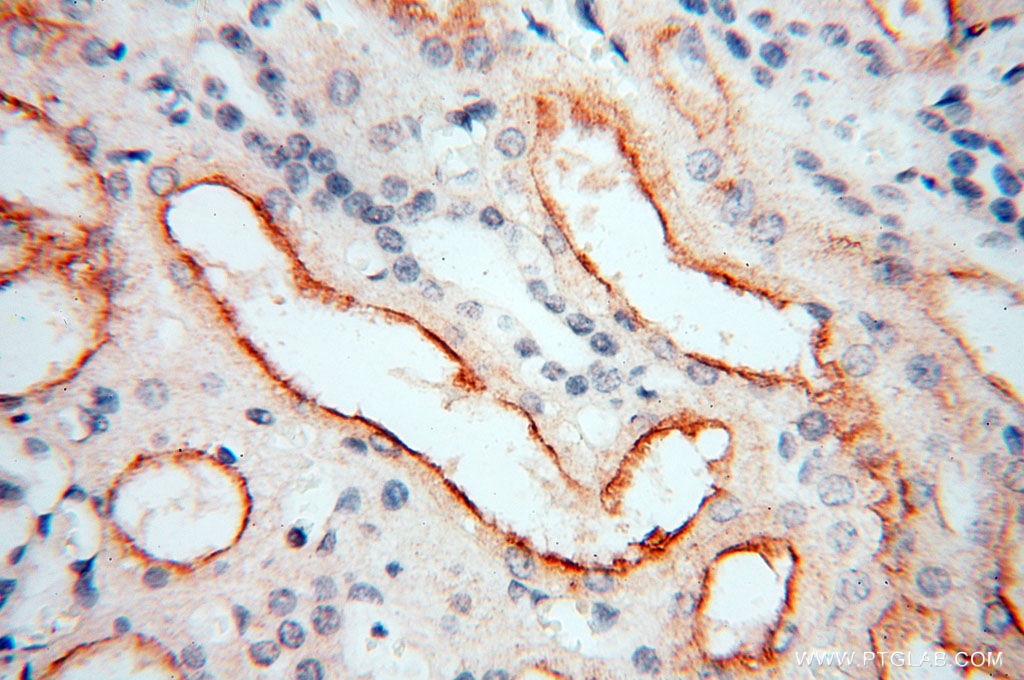
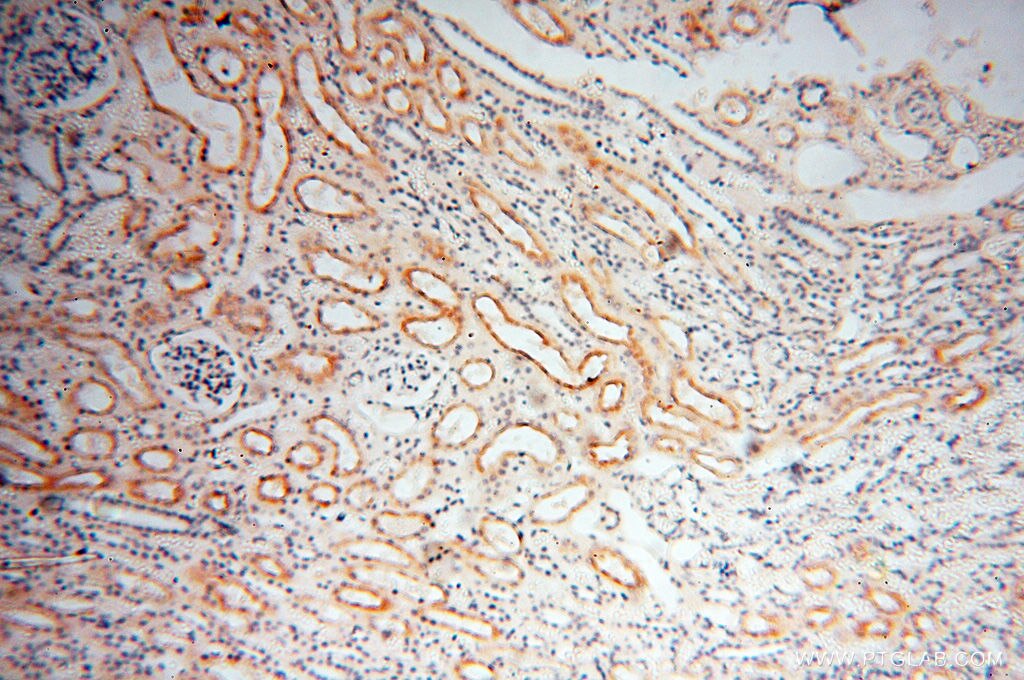
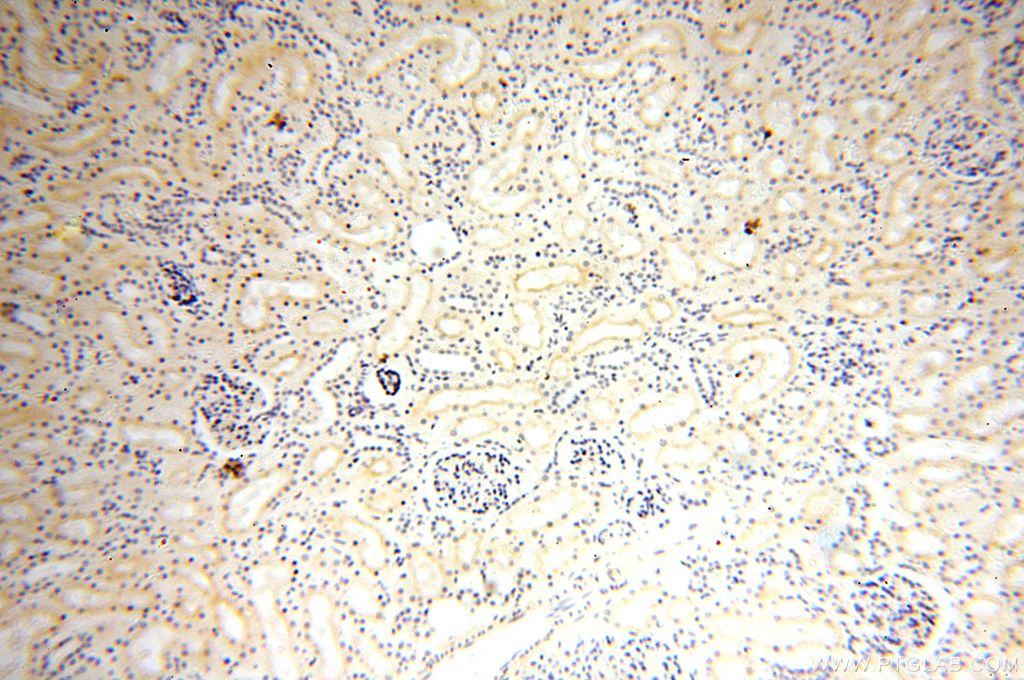
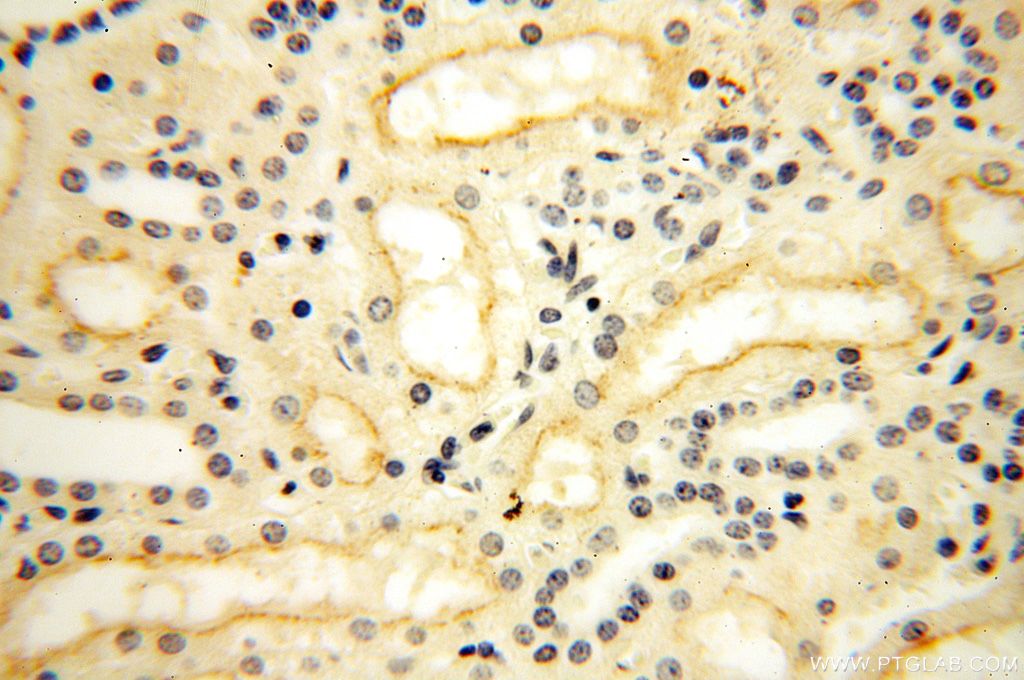

Tested Applications
| Positive IHC detected in | human kidney tissue Note: suggested antigen retrieval with TE buffer pH 9.0; (*) Alternatively, antigen retrieval may be performed with citrate buffer pH 6.0 |
Recommended dilution
| Application | Dilution |
|---|---|
| Immunohistochemistry (IHC) | IHC : 1:20-1:200 |
| It is recommended that this reagent should be titrated in each testing system to obtain optimal results. | |
| Sample-dependent, Check data in validation data gallery. | |
Product Information
17026-1-AP targets GPR132 in IHC, ELISA applications and shows reactivity with human, mouse, rat samples.
| Tested Reactivity | human, mouse, rat |
| Cited Reactivity | human, mouse |
| Host / Isotype | Rabbit / IgG |
| Class | Polyclonal |
| Type | Antibody |
| Immunogen |
CatNo: Ag10325 Product name: Recombinant human GPR132 protein Source: e coli.-derived, PET28a Tag: 6*His Domain: 214-380 aa of BC084546 Sequence: IIAFTNHRIFRSIKQSMGLSAAQKAKVKHSAIAVVVIFLVCFAPYHLVLLVKAAAFSYYRGDRNAMCGLEERLYTASVVFLCLSTVNGVADPIIYVLATDHSRQEVSRIHKGWKEWSMKTDVTRLTHSRDTEELQSPVALADHYTFSRPVHPPGSPCPAKRLIEESC Predict reactive species |
| Full Name | G protein-coupled receptor 132 |
| Calculated Molecular Weight | 380 aa, 43 kDa |
| GenBank Accession Number | BC084546 |
| Gene Symbol | GPR132 |
| Gene ID (NCBI) | 29933 |
| RRID | AB_2113375 |
| Conjugate | Unconjugated |
| Form | Liquid |
| Purification Method | Antigen affinity purification |
| UNIPROT ID | Q9UNW8 |
| Storage Buffer | PBS with 0.02% sodium azide and 50% glycerol, pH 7.3. |
| Storage Conditions | Store at -20°C. Stable for one year after shipment. Aliquoting is unnecessary for -20oC storage. 20ul sizes contain 0.1% BSA. |
Background Information
GPR132, also known as G2A (G2 accumulation protein), belongs to the G-protein coupled receptor (GPCR) 1 family. GPR132 is a DNA damage and stress inducible GPCR that blocks cells in G2/M. It functions at the G2/M checkpoint to delay mitosis and may serve as a mechanism for T and B cells and other cell types to slow their proliferation and repair damaged DNA to ensure proper replication (PMID: 9770487). Lysophosphatidylcholine (LPC) is a high affinity ligand for GPR132 (PMID: 15653487).
Protocols
| Product Specific Protocols | |
|---|---|
| IHC protocol for GPR132 antibody 17026-1-AP | Download protocol |
| Standard Protocols | |
|---|---|
| Click here to view our Standard Protocols |
Publications
What published studies show
The GPR132 Polyclonal antibody (Cat# 17026-1-AP) has been cited in 5 publications across journals including Nature Communications, Journal of the European Academy of Dermatology and Venereology, Frontiers in Oncology, Neuroscience Research, and Journal of Hepato-Biliary-Pancreatic Sciences. The associated research fields span cardiovascular pathology, dermatology (psoriasis), oncology (tumor malignancy), neuroscience (astrocyte migration), and hepatobiliary disease.
| Species | Application | Title |
|---|---|---|
Nat Commun Lysophosphatidylserine induces necrosis in pressure overloaded male mouse hearts via G protein coupled receptor 34 | ||
J Eur Acad Dermatol Venereol Lysophosphatidylcholine facilitates the pathogenesis of psoriasis through activating keratinocytes and T cells differentiation via glycolysis | ||
Front Oncol Lactate increases tumor malignancy by promoting tumor small extracellular vesicles production via the GPR81-cAMP-PKA-HIF-1α axis
| ||
J Hepatobiliary Pancreat Sci Partial characterization of proapoptotic action of biliary deteriorated lipids on biliary epithelial cells in pancreaticobiliary diseases. |


