Tested Applications
| Positive WB detected in | MDA-MB-231 cells, human spleen tissue, HeLa cells, A549 cells, U-251 cells, HUVEC cells, pig spleen tissue |
| Positive IP detected in | HeLa cells |
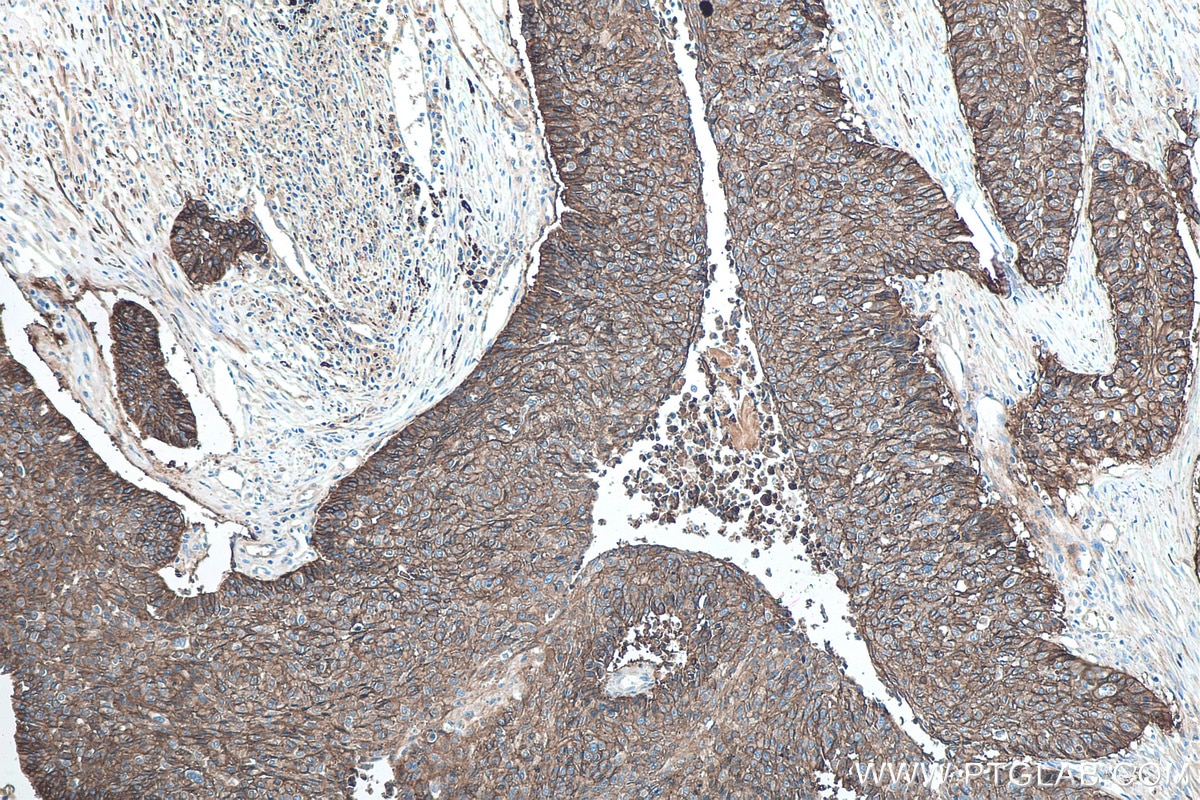
| Positive IHC detected in | human lung cancer tissue, human colon cancer tissue, human oesophagus cancer tissue, human breast cancer tissue, human tonsillitis tissue Note: suggested antigen retrieval with TE buffer pH 9.0; (*) Alternatively, antigen retrieval may be performed with citrate buffer pH 6.0 |
| Positive IF-P detected in | human colon cancer tissue |
| Positive IF/ICC detected in | A431 cells |
Recommended dilution
| Application | Dilution |
|---|---|
| Western Blot (WB) | WB : 1:5000-1:50000 |
| Immunoprecipitation (IP) | IP : 0.5-4.0 ug for 1.0-3.0 mg of total protein lysate |
| Immunohistochemistry (IHC) | IHC : 1:200-1:1000 |
| Immunofluorescence (IF)-P | IF-P : 1:200-1:800 |
| Immunofluorescence (IF)/ICC | IF/ICC : 1:400-1:1600 |
| It is recommended that this reagent should be titrated in each testing system to obtain optimal results. | |
| Sample-dependent, Check data in validation data gallery. | |
Product Information
60224-1-Ig targets CD44 in WB, IHC, IF/ICC, IF-P, IP, CoIP, ELISA, Blocking assay applications and shows reactivity with human, pig samples.
| Tested Reactivity | human, pig |
| Cited Reactivity | human, rat, pig, rabbit |
| Host / Isotype | Mouse / IgG2a |
| Class | Monoclonal |
| Type | Antibody |
| Immunogen |
CatNo: Ag7633 Product name: Recombinant human CD44 protein Source: e coli.-derived, PET28a Tag: 6*His Domain: 28-380 aa of BC004372 Sequence: CRFAGVFHVEKNGRYSISRTEAADLCKAFNSTLPTMAQMEKALSIGFETCRYGFIEGHVVIPRIHPNSICAANNTGVYILTSNTSQYDTYCFNASAPPEEDCTSVTDLPNAFDGPITITIVNRDGTRYVQKGEYRTNPEDIYPSNPTDDDVSSGSSSERSSTSGGYIFYTFSTVHPIPDEDSPWITDSTDRIPATSTSSNTISAGWEPNEENEDERDRHLSFSGSGIDDDEDFISSTISTTPRAFDHTKQNQDWTQWNPSHSNPEVLLQTTTRMTDVDRNGTTAYEGNWNPEAHPPLIHHEHHEEEETPHSTSTIQATPSSTTEETATQKEQWFGNRWHEGYRQTPREDSHST Predict reactive species |
| Full Name | CD44 molecule (Indian blood group) |
| Calculated Molecular Weight | 742 aa, 82 kDa |
| Observed Molecular Weight | 80-95 kDa |
| GenBank Accession Number | BC004372 |
| Gene Symbol | CD44 |
| Gene ID (NCBI) | 960 |
| ENSEMBL Gene ID | ENSG00000026508 |
| RRID | AB_11042767 |
| Conjugate | Unconjugated |
| Form | Liquid |
| Purification Method | Protein A purification |
| UNIPROT ID | P16070 |
| Storage Buffer | PBS with 0.02% sodium azide and 50% glycerol, pH 7.3. |
| Storage Conditions | Store at -20°C. Stable for one year after shipment. Aliquoting is unnecessary for -20oC storage. 20ul sizes contain 0.1% BSA. |
Background Information
CD44 is a type I transmembrane glycoprotein that mediates cell-cell and cell-matrix interactions through its affinity for hyaluronic acid (HA) and possibly also through its affinity for other ligands. Adhesion with HA plays an important role in cell migration, tumor growth and progression. CD44 is also involved in lymphocyte activation, recirculation and homing, and in hematopoiesis. This protein exists in multiple forms (with molecular weight ranging from 16 kDa to over 200 kDa) generated by alternative RNA splicing and extensive post-translational modifications.
Protocols
| Product Specific Protocols | |
|---|---|
| IF protocol for CD44 antibody 60224-1-Ig | Download protocol |
| IHC protocol for CD44 antibody 60224-1-Ig | Download protocol |
| IP protocol for CD44 antibody 60224-1-Ig | Download protocol |
| WB protocol for CD44 antibody 60224-1-Ig | Download protocol |
| Standard Protocols | |
|---|---|
| Click here to view our Standard Protocols |
Publications
What published studies show
The CD44 Monoclonal antibody (Cat# 60224-1-Ig) has accumulated 114 citations published in high-impact journals including Nature, Nat Commun, Nat Methods, Nat Nanotechnol, Cell Stem Cell, Theranostics, Adv Sci, Biomaterials, Cancer Lett, Oncogene, Stem Cell Res Ther, and iScience. Key research fields include cancer stemness and EMT, tumor microenvironment, immunotherapy, bone and tissue regeneration, neuroinflammation, ferroptosis, reproductive biology, kidney disease, and biomaterials/nanotechnology applications across multiple cancer types.
| Species | Application | Title |
|---|---|---|
Signal Transduct Target Ther Photodynamic gel-bombs enhance tumor penetration and downstream synergistic therapies | ||
Nat Nanotechnol A bispecific nanosystem activates endogenous natural killer cells in the bone marrow for haematologic malignancies therapy | ||
Nat Methods Visualizing the native cellular organization by coupling cryofixation with expansion microscopy (Cryo-ExM). | ||
Bioact Mater Spatiotemporally programming the immune-osteogenic cascade with a dual-immunomodulatory scaffold for functional bone regeneration. | ||
Cell Stem Cell Lgr5-expressing secretory cells form a Wnt inhibitory niche in cartilage critical for chondrocyte identity |
Reviews
What customers say
Both reviews are for Western Blot applications. One user (4/5) reported the antibody stained cell supernatants effectively but suggested using a higher concentration. The other (5/5) confirmed it worked well at a 1:1000 dilution on glioblastoma cells. Overall, users find the antibody reliable for WB, with a minor note that increasing the concentration may improve signal in some samples.
The reviews below have been submitted by verified Proteintech customers who received an incentive for providing their feedback.
Lana (Verified Customer) (10-14-2025) | Antibody performed well and stained supernatants effectively, though I do recommend increasing antibody concentration.
 |
Udesh (Verified Customer) (08-16-2023) | Worked well for WB at 1:1000
|