
The Unexpected Cell Type Behind Heart Attacks and Strokes
Written by: Sofija Sundman, PhD Student at the Department of Molecular Medicine and Surgery, Karolinska Institutet
Atherosclerosis – the world’s deadliest disease
Cardiovascular disease is the leading cause of death today and a major driver of global healthcare costs1. The biggest culprit behind these trends is atherosclerosis – a cardiovascular disease characterized by the emergence of atherosclerotic plaques2,3. These lesions are a buildup of lipids, extracellular matrix, cells, and calcifications that form underneath the endothelial layer of larger and mid-sized arteries5. Over several decades, the plaque slowly grows and develops, and in some patients, it eventually ruptures. In these cases, the plaque material encountering blood in the vessel triggers a blood clot formation. If this clot then travels to the brain, it can halt blood flow and cause a stroke, and if it reaches a vessel in the heart, a heart attack may ensue due to arterial blockage6.
Atherosclerotic lesions differ in their propensity to rupture: those that are more likely to stay intact are considered stable plaques, while those that confer more risk are called vulnerable or unstable plaques (Figure 1)7,8. Stable lesions are marked by a thick protective layer called the fibrous cap, high collagen content, and low inflammation. On the other hand, vulnerable ones have a thin cap, an elevated inflammatory cell content, and a large necrotic core, at times with bleeding within the plaque itself5. However, despite large efforts in the field, it is not yet completely understood why some plaques become vulnerable. The clue may lie in the cells involved in the disease mechanism.
Which cells make up the plaque?
To a layperson, it may seem like the plaque is just a collection of fat that gets accumulated within the vessel wall. However, many different cell types participate in the local disease development, which past decades of research have shown. Recent technological breakthroughs in the field of single-cell RNA sequencing (scRNA-seq) have offered previously inaccessible insights into which cells contribute to atherosclerotic plaque formation: Those include smooth muscle cells (SMCs), macrophages, T cells, fibroblasts, endothelial cells, and other cell types present in smaller proportions9. Lineage tracing experiments in mouse models that track cells throughout disease development revealed that SMCs in fact make up the majority of the cells in atherosclerotic lesions, namely through a process called transdifferentiation10,11. The SMCs change their phenotype and function, ultimately resembling other cell types entirely. This process results in a multitude of effects on the lesion environment, depending on which characteristics SMCs obtain through transdifferentiation.
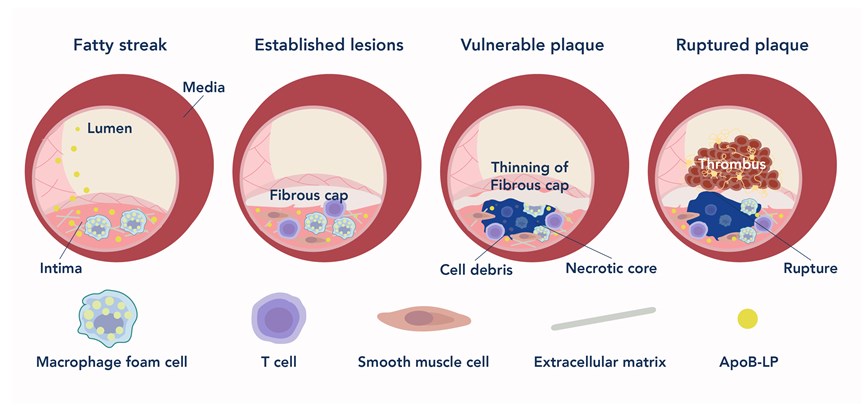
Figure 1: Schematic representation of a normal artery, a stable atherosclerotic plaque, a complex vulnerable lesion, and a ruptured plaque. Adapted from Moore and Tabas (2011)4.
The complex role of smooth muscle cells
SMCs are the major constituents of the healthy arterial wall. Their primary roles in health are providing structural integrity and regulation of vascular tone12. In accordance with these functions as muscle cells, they are normally contractile, with high expression of contractility markers such as ACTA2, MYH11, CNN1, and others13. Available antibodies against each marker are linked. Such markers can be detected in abundance by immunohistochemistry in normal arteries. During vascular disease development, however, SMCs lose their usual phenotype and canonical markers, acquiring other functions throughout the process (Figure 2). In the context of the atherosclerotic plaque, SMC-derived cells might resemble fibroblasts, macrophages, foam cells, osteochondrocytes, and at times, other cell types in smaller proportions14. These can in turn be observed using a number of markers dependant on the phenotype – for example, osteochondrogenic SMCs are marked by osteopontin (OPN) and RUNX2, while fibroblast-like SMCs express TCF2115.
Importantly, these phenotypic changes of SMCs have a large influence on plaque vulnerability. If there are many fibroblast-like SMC-derived cells in the fibrous cap, they will produce high amounts of extracellular matrix that thicken the cap and therefore protect against rupture. On the other hand, if there are many transdifferentiated SMCs with acquired pro-inflammatory functions, they will result in recruitment of more immune cells, which in turn secrete matrix metalloproteinases that degrade the fibrous material in the cap16. These are only a few examples of the many ways in which SMC transdifferentiation can directly impact plaque stability. They illustrate a key importance of SMCs in the outcome of the disease, and therefore in each patient’s risk profile for stroke and heart attack.

Figure 2: Phenotypical changes of SMCs during vascular disease development.
Translational perspectives
Currently, atherosclerosis is mainly managed with lifestyle changes, often together with medicines such as statins, which lower blood cholesterol levels. At advanced stages, surgical approaches such as stenting or total plaque removal may also be applied5. Although these interventions are effective, they each have their limitations. Moreover, the decline in the mortality rate observed in the last few decades is flatlining17. This all points towards a need for a new breakthrough in treatment strategies for atherosclerosis.
Targeting SMCs and their plastic phenotype could be the answer. With this in mind, recent years have seen a large research effort to find SMC-specific therapeutic approaches for vascular disease15. In atherosclerosis, the plasticity of SMCs could be exploited so that they are therapeutically directed towards plaque-stabilizing phenotypes, such as the ones contributing to fibrous cap thickness, and away from destabilizing pro-inflammatory ones. Previously unknown SMC-specific molecular targets for such innovative treatments are being uncovered and explored at a fast pace. Although no SMC-focused therapeutics have entered clinical trials, a pro-efferocytosis anti-CD47 therapeutic currently being tested also shows beneficial effects on SMCs in the plaque15,18. This kind of research is highly promising and may eventually result in a new generation of therapies for atherosclerosis.
In conclusion, SMCs are a central component of atherosclerosis development, progression, and outcome, but also might be central for novel treatments of this disease.
References
-
Roth, GA, Mensah, GA, Johnson, CO, Addolorato, G, Ammirati, E, Baddour, LM, Barengo, NC, Beaton, A, Benjamin, EJ, Benziger, CP, et al. "Global Burden of Cardiovascular Diseases and Risk Factors, 1990–2019: Update From the GBD 2019 Study." Journal of the American College of Cardiology. 2020;76:2982-2982. doi: 10.1016/J.JACC.2020.11.010
-
Barquera, S, Pedroza-Tobías, A, Medina, C, Hernández-Barrera, L, Bibbins-Domingo, K, Lozano, R, Moran, AE. "Global Overview of the Epidemiology of Atherosclerotic Cardiovascular Disease." Archives of Medical Research. 2015;46:328-338. doi: 10.1016/J.ARCMED.2015.06.006
-
Douglas, G, Channon, KM. "The pathogenesis of atherosclerosis." Medicine. 2014;42:480-484. doi: https://doi.org/10.1016/j.mpmed.2014.06.011
-
Moore, KJ, Tabas, I. "Macrophages in the Pathogenesis of Atherosclerosis." Cell. 2011;145:341-355. doi: 10.1016/j.cell.2011.04.005
-
Libby, P, Buring, JE, Badimon, L, Hansson, GK, Deanfield, J, Bittencourt, MS, Tokgözoğlu, L, Lewis, EF. "Atherosclerosis." Nature Reviews Disease Primers. 2019;5:56. doi: 10.1038/s41572-019-0106-z
-
Jebari-Benslaiman, S, Galicia-García, U, Larrea-Sebal, A, Olaetxea, JR, Alloza, I, Vandenbroeck, K, Benito-Vicente, A, Martín, C. "Pathophysiology of Atherosclerosis." International Journal of Molecular Sciences. 2022;23:3346. doi: 10.3390/ijms23063346.
-
Chemaly, M, Marlevi, D, Iglesias, MJ, Lengquist, M, Kronqvist, M, Bos, D, van Dam-Nolen, DHK, van der Kolk, A, Hendrikse, J, Kassem, M, et al. "Biliverdin Reductase B Is a Plasma Biomarker for Intraplaque Hemorrhage and a Predictor of Ischemic Stroke in Patients with Symptomatic Carotid Atherosclerosis." Biomolecules. 2023;13. doi: 10.3390/biom13060882
-
Currie, G, Kiat, H. "Beyond the Lumen: Molecular Imaging to Unmask Vulnerable Coronary Plaques." Journal of Cardiovascular Development and Disease. 2025;12:51. doi: 10.3390/jcdd12020051.
-
Traeuble, KA-O, Munz, MA-O, Pauli, JA-O, Sachs, NA-OX, Vafadarnejad, E, Carrillo-Roa, TA-O, Maegdefessel, LA-O, Kastner, PA-O, Heinig, MA-O. "Integrated single-cell atlas of human atherosclerotic plaques." Nature Communications. 2025;16:8255.
-
Bentzon, JF, Majesky, MW. "Lineage tracking of origin and fate of smooth muscle cells in atherosclerosis." Cardiovascular Research. 2017;114:492-500. doi: 10.1093/cvr/cvx251
-
Shankman, LS, Gomez, D, Cherepanova, OA, Salmon, M, Alencar, GF, Haskins, RM, Swiatlowska, P, Newman, AAC, Greene, ES, Straub, AC, et al. "KLF4-dependent phenotypic modulation of smooth muscle cells has a key role in atherosclerotic plaque pathogenesis." Nature Medicine. 2015;21:628-637. doi: 10.1038/nm.3866
-
Chen, R, McVey, DG, Shen, D, Huang, X, Ye, S. "Phenotypic Switching of Vascular Smooth Muscle Cells in Atherosclerosis." Journal of the American Heart Association. 2023;12:e031121. doi:10.1161/JAHA.123.031121
-
Espinosa-Diez, C, Mandi, V, Du, M, Liu, M, Gomez, D. "Smooth muscle cells in atherosclerosis: clones but not carbon copies." JVS-Vascular Science. 2021;2:136-148. doi: 10.1016/j.jvssci.2021.02.002
-
Alencar, GF, Owsiany, KM, Karnewar, S, Sukhavasi, K, Mocci, G, Nguyen, AT, Williams, CM, Shamsuzzaman, S, Mokry, M, Henderson, CA, et al. "Stem Cell Pluripotency Genes Klf4 and Oct4 Regulate Complex SMC Phenotypic Changes Critical in Late-Stage Atherosclerotic Lesion Pathogenesis." Circulation. 2020;142:2045-2059. doi: 10.1161/circulationaha.120.046672
-
Azar, P, Jarr, K-U, Gomez, D, Jørgensen, HF, Leeper, NJ, Bochaton-Piallat, M-L. "Smooth muscle cells in atherosclerosis: essential but overlooked translational perspectives." European Heart Journal. 2025. doi: 10.1093/eurheartj/ehaf337
-
Grootaert, MOJ, Bennett, MR. "Vascular smooth muscle cells in atherosclerosis: time for a re-assessment." Cardiovascular Research. 2021;117:2326-2339. doi: 10.1093/cvr/cvab046
-
Lopez, AD, Adair, T. "Is the long-term decline in cardiovascular-disease mortality in high-income countries over? Evidence from national vital statistics." International Journal of Epidemiology. 2019;48:1815-1823. doi: 10.1093/IJE/DYZ143
-
Pervaiz, N, Mehmood, R, Aithabathula, RV, Kathuria, I, Ahn, W, Le, B-T, Kim, K-S, Singh, UP, Csanyi, G, Singla, B. "Smooth muscle cell-specific CD47 deletion suppresses atherosclerosis." Life Sciences. 2025;361:123315. doi: 10.1016/j.lfs.2024.123315.

Related Content
https://www.ptglab.com/news/blog/primary-cilia-and-regulation-of-blood-pressure-the-silent-killer/
https://www.ptglab.com/news/blog/the-heart-of-science/
https://www.ptglab.com/news/blog/hidden-secrets-of-the-heart/
https://www.ptglab.com/videos/immunohistochemistry/immunohistochemistry-ihc-the-basics-and-beyond/
Support
Newsletter Signup
Stay up-to-date with our latest news and events. New to Proteintech? Get 10% off your first order when you sign up.