
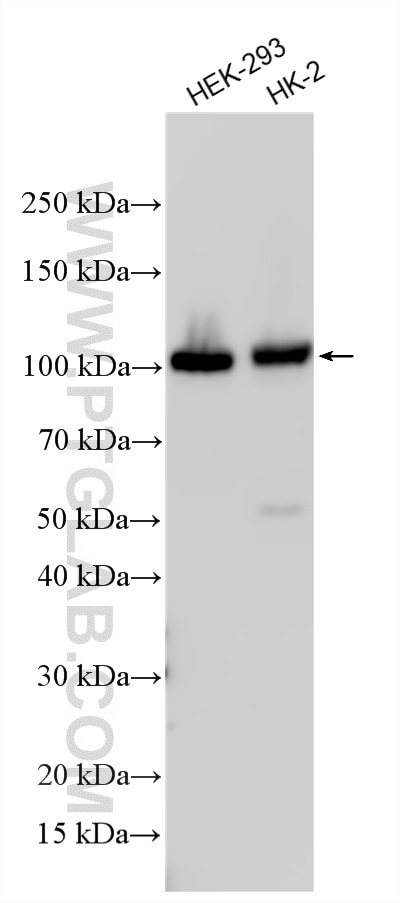



Tested Applications
| Positive WB detected in | HEK-293 cells, MCF-7 cells, mouse tissue, HK-2 cells |
| Positive IHC detected in | mouse brain tissue, human ovary tumor tissue Note: suggested antigen retrieval with TE buffer pH 9.0; (*) Alternatively, antigen retrieval may be performed with citrate buffer pH 6.0 |
Recommended dilution
| Application | Dilution |
|---|---|
| Western Blot (WB) | WB : 1:2000-1:16000 |
| Immunohistochemistry (IHC) | IHC : 1:50-1:500 |
| It is recommended that this reagent should be titrated in each testing system to obtain optimal results. | |
| Sample-dependent, Check data in validation data gallery. | |
Product Information
14392-1-AP targets YTHDC1 in WB, IHC, IF, IP, CoIP, RIP, ELISA applications and shows reactivity with human, mouse, rat samples.
| Tested Reactivity | human, mouse, rat |
| Cited Reactivity | human, mouse, rat |
| Host / Isotype | Rabbit / IgG |
| Class | Polyclonal |
| Type | Antibody |
| Immunogen |
CatNo: Ag5882 Product name: Recombinant human YTHDC1 protein Source: e coli.-derived, PGEX-4T Tag: GST Domain: 360-709 aa of BC053863 Sequence: STLPVNEKKLNLAFRSARSVILIFSVRESGKFQGFARLSSESHHGGSPIHWVLPAGMSAKMLGGVFKIDWICRRELPFTKSAHLTNPWNEHKPVKIGRDGQEIELECGTQLCLLFPPDESIDLYQVIHKMRHKRRMHSQPRSRGRPSRREPVRDVGRRRPEDYDIHNSRKKPRIDYPPEFHQRPGYLKDPRYQEVDRRFSGVRRDVFLNGSYNDYVREFHNMGPPPPWQGMPPYPGMEQPPHHPYYQHHAPPPQAHPPYSGHHPVPHEARYRDKRVHDYDMRVDDFLRRTQAVVSGRRSRPRERDRERERDRPRDNRRDRERDRGRDRERERERLCDRDRDRGERGRYRR Predict reactive species |
| Full Name | YTH domain containing 1 |
| Calculated Molecular Weight | 85 kDa |
| Observed Molecular Weight | ~100 kDa |
| GenBank Accession Number | BC053863 |
| Gene Symbol | YTHDC1 |
| Gene ID (NCBI) | 91746 |
| RRID | AB_2878052 |
| Conjugate | Unconjugated |
| Form | Liquid |
| Purification Method | Antigen affinity purification |
| UNIPROT ID | Q96MU7 |
| Storage Buffer | PBS with 0.02% sodium azide and 50% glycerol, pH 7.3. |
| Storage Conditions | Store at -20°C. Stable for one year after shipment. Aliquoting is unnecessary for -20oC storage. 20ul sizes contain 0.1% BSA. |
Background Information
YTHDC1, also named as KIAA1966 or YT521, is a 727 animo acid protein, which contains 1 YTH domain. YTHDC1 localizes in the nucleus and Interacts with EMD, KHDRBS1/SAM68, KHDRBS3, TRA2B/SFRS10, SC35 and SF2. YTHDC1 as a RNA-binding protein that regulates alternative splice site selection. The calcualted molecular weight of YTHDC1 is 85 kDa, but modified TFEB is about 110 kDa (PMID: 10973987 ).
Protocols
| Product Specific Protocols | |
|---|---|
| IHC protocol for YTHDC1 antibody 14392-1-AP | Download protocol |
| WB protocol for YTHDC1 antibody 14392-1-AP | Download protocol |
| Standard Protocols | |
|---|---|
| Click here to view our Standard Protocols |
Publications
What published studies show
The YTHDC1 Polyclonal antibody (Cat# 14392-1-AP) has 83 citations. These appear in high-impact journals including Nature, Cell, Nature Communications, Science Advances, Cell Death & Differentiation, Cell Reports, Oncogene, and PLoS Biology. Research fields span m6A RNA methylation regulation, cancer biology (colorectal, liver, lung, glioblastoma, ovarian, and pancreatic cancers), cardiovascular disease, neuroinflammation, metabolism, and viral replication. Applications include WB, IF, IHC, IP, CoIP, and RIP.
| Species | Application | Title |
|---|---|---|
Cell Comprehensive human proteome profiles across a 50-year lifespan reveal aging trajectories and signatures | ||
Mol Cancer METTL3-mediated m(6)A modification of CACNA1E promotes osteosarcoma progression and chemoresistance by enhancing WNT7B-mediated Ca(2+) signaling. | ||
Nat Commun USP5 stabilizes YTHDF1 to control cancer immune surveillance through mTORC1-mediated phosphorylation | ||
Nat Commun N6-methyladenosine of Spi2a attenuates inflammation and sepsis-associated myocardial dysfunction in mice |


