

Tested Applications
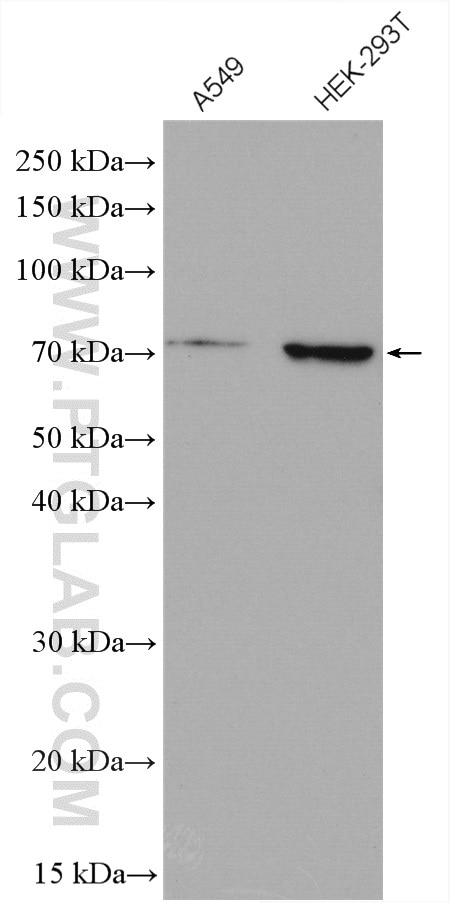
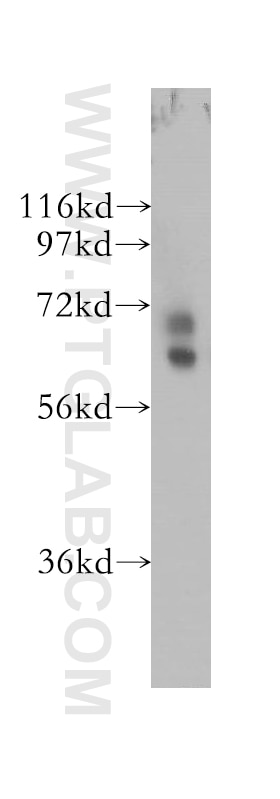
| Positive WB detected in | A549 cells, human lung tissue, HEK-293T cells |
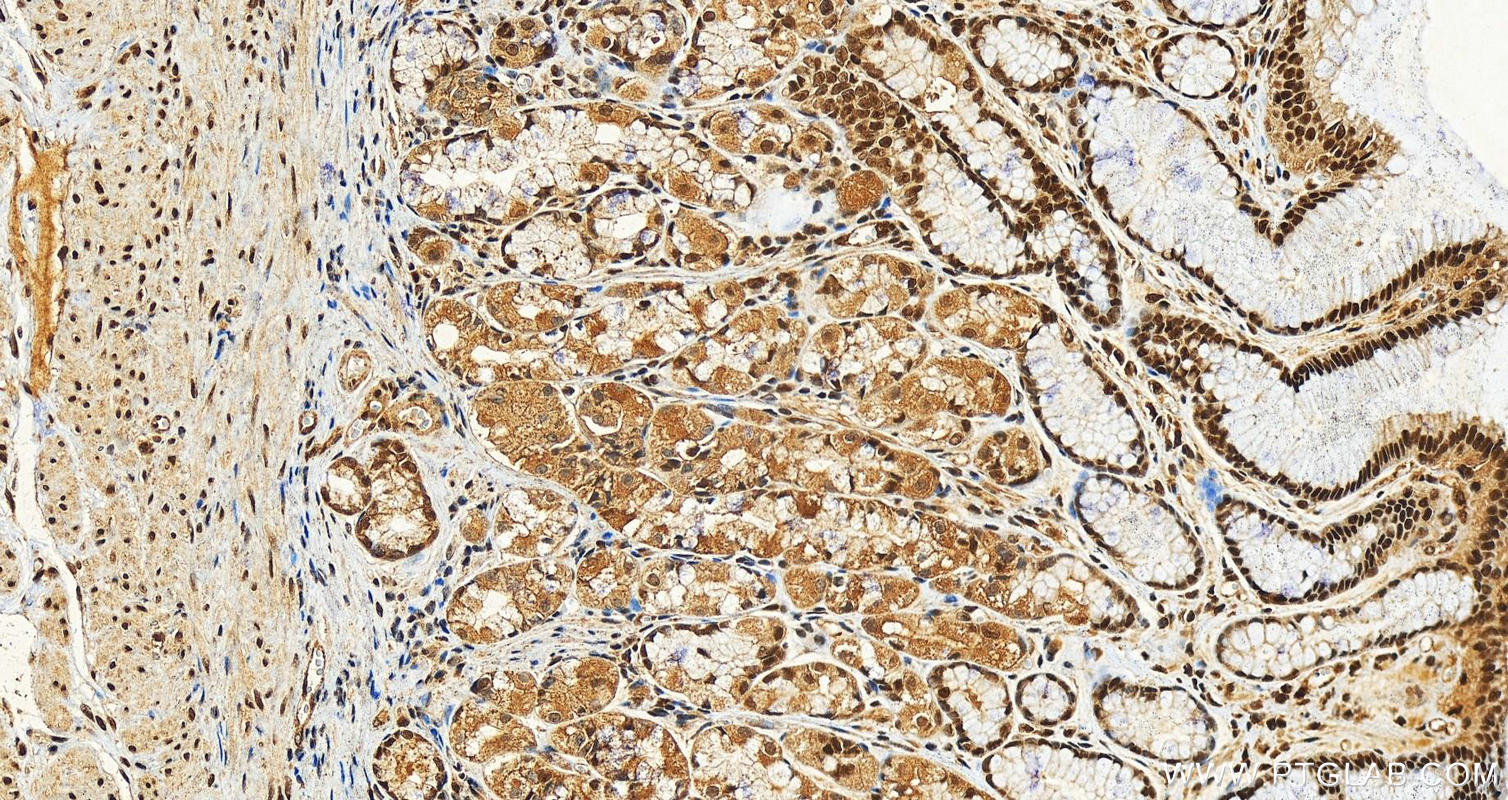
| Positive IHC detected in | human stomach tissue Note: suggested antigen retrieval with TE buffer pH 9.0; (*) Alternatively, antigen retrieval may be performed with citrate buffer pH 6.0 |
Recommended dilution
| Application | Dilution |
|---|---|
| Western Blot (WB) | WB : 1:500-1:3000 |
| Immunohistochemistry (IHC) | IHC : 1:50-1:500 |
| It is recommended that this reagent should be titrated in each testing system to obtain optimal results. | |
| Sample-dependent, Check data in validation data gallery. | |
Product Information
12482-1-AP targets NRF1/nuclear respiratory factor 1 in WB, IHC, IF, ELISA applications and shows reactivity with human, mouse, rat samples.
| Tested Reactivity | human, mouse, rat |
| Cited Reactivity | human, mouse, rat, pig, chicken, zebrafish, goat, duck, ducks |
| Host / Isotype | Rabbit / IgG |
| Class | Polyclonal |
| Type | Antibody |
| Immunogen |
CatNo: Ag3172 Product name: Recombinant human NRF1 protein Source: e coli.-derived, PGEX-4T Tag: GST Domain: 213-522 aa of BC016925 Sequence: LKYSTGRGKPGWGKESCKPIWWPEDIPWANVRSDVRTEEQKQRVSWTQALRTIVKNCYKQHGREDLLYAFEDQQTQTQATATHSIAHLVPSQTVVQTFSNPDGTVSLIQVGTGATVATLADASELPTTVTVAQVNYSAVADGEVEQNWATLQGGEMTIQTTQASEATQAVASLAEAAVAASQEMQQGATVTMALNSEAAAHAVATLAEATLQGGGQIVLSGETAAAVGALTGVQDANGLFMADRAGRKWILTDKATGLVQIPVSMYQTVVTSLAQGNGPVQVAMAPVTTRISDSAVTMDGQAVEVVTLEQ Predict reactive species |
| Full Name | nuclear respiratory factor 1 |
| Calculated Molecular Weight | 522 aa, 56 kDa |
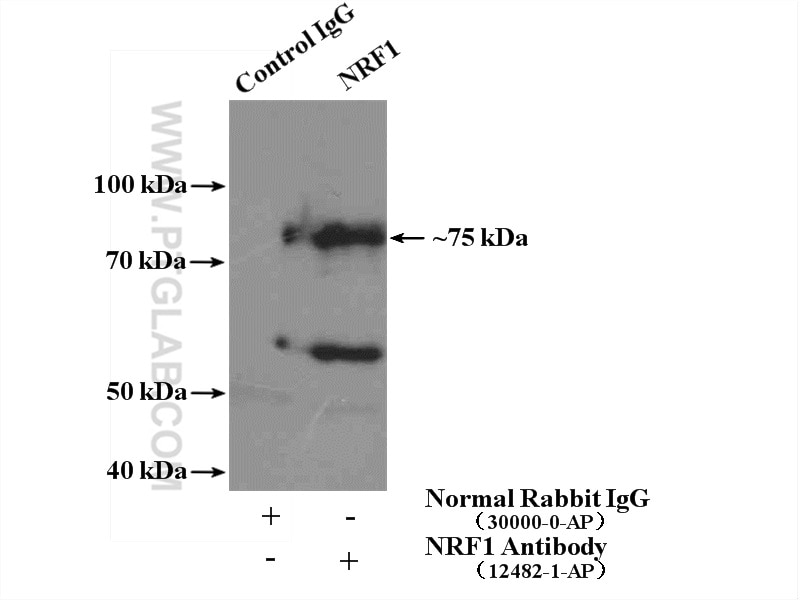
| Observed Molecular Weight | 67 kDa, 45 kDa |
| GenBank Accession Number | BC016925 |
| Gene Symbol | NRF1 |
| Gene ID (NCBI) | 4899 |
| RRID | AB_2282876 |
| Conjugate | Unconjugated |
| Form | Liquid |
| Purification Method | Antigen affinity purification |
| UNIPROT ID | Q16656 |
| Storage Buffer | PBS with 0.02% sodium azide and 50% glycerol, pH 7.3. |
| Storage Conditions | Store at -20°C. Stable for one year after shipment. Aliquoting is unnecessary for -20oC storage. 20ul sizes contain 0.1% BSA. |
Background Information
NRF1, also named as Alpha-pal and NRF-1, belongs to the NRF1/Ewg family. It is a transcription factor that activates the expression of the EIF2S1 (EIF2-alpha) gene. NRF1 is implicated in the control of nuclear genes required for respiration, heme biosynthesis, and mitochondrial DNA transcription and replication. It plays a critical role in regulating the expression of many antioxidant response element (ARE)-dependent genes. NRF1 exists various isoforms and long isoform is about 67 kDa and short isoform is about 45 kDa.
Protocols
| Product Specific Protocols | |
|---|---|
| IHC protocol for NRF1/nuclear respiratory factor 1 antibody 12482-1-AP | Download protocol |
| IP protocol for NRF1/nuclear respiratory factor 1 antibody 12482-1-AP | Download protocol |
| WB protocol for NRF1/nuclear respiratory factor 1 antibody 12482-1-AP | Download protocol |
| Standard Protocols | |
|---|---|
| Click here to view our Standard Protocols |
Publications
What published studies show
Anti-PGC-1α antibody (Cat# 12482-1-AP) has 144 total citations published in journals including Nature, Nature Communications, Autophagy, Signal Transduction and Targeted Therapy, Redox Biology, Journal of Advanced Research, Phytomedicine, Free Radical Biology and Medicine, Journal of Ethnopharmacology, FASEB Journal, and others. Associated research fields include mitochondrial biogenesis, oxidative stress, neurodegeneration, cardiovascular disease, hepatic disorders, diabetes, cancer, aging, mitophagy, metabolic regulation, and reproductive biology.
| Species | Application | Title |
|---|---|---|
Signal Transduct Target Ther Short-chain acyl-CoA dehydrogenase initiates mtDNA demethylation and leakage to fuel antitumor immunity in colorectal cancer. | ||
Autophagy HTLV-1 Tax induces PINK1-PRKN/parkin-dependent mitophagy to mitigate activation of the CGAS-STING1 pathway. | ||
Autophagy Porcine reproductive and respiratory syndrome virus hijacks the non-canonical enzymatic function of PHGDH to arrest autophagic flux for viral replication. | ||
Nat Commun ZHX2 emerges as a negative regulator of mitochondrial oxidative phosphorylation during acute liver injury | ||
Nat Commun Single-cell exon deletion profiling reveals splicing events that shape gene expression and cell state dynamics. |


