

Tested Applications
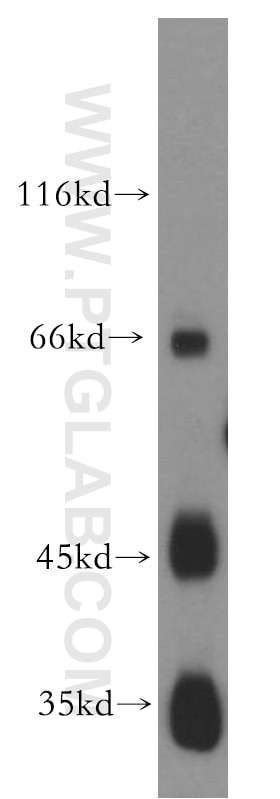
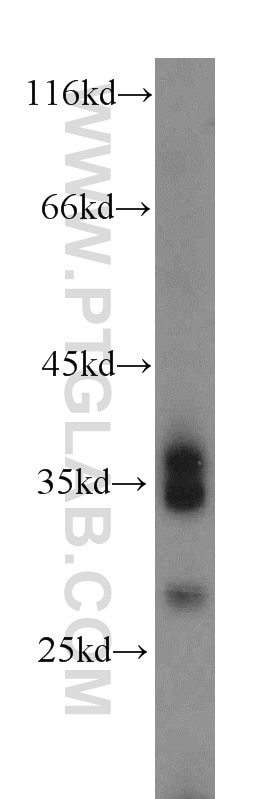
| Positive WB detected in | human placenta tissue, human heart tissue |
Recommended dilution
| Application | Dilution |
|---|---|
| Western Blot (WB) | WB : 1:500-1:2000 |
| It is recommended that this reagent should be titrated in each testing system to obtain optimal results. | |
| Sample-dependent, Check data in validation data gallery. | |
Product Information
12972-1-AP targets JAM2 in WB, ELISA applications and shows reactivity with human, mouse, rat samples.
| Tested Reactivity | human, mouse, rat |
| Cited Reactivity | human, mouse, rat |
| Host / Isotype | Rabbit / IgG |
| Class | Polyclonal |
| Type | Antibody |
| Immunogen |
CatNo: Ag3431 Product name: Recombinant human JAM2 protein Source: e coli.-derived, PGEX-4T Tag: GST Domain: 1-298 aa of BC017779 Sequence: MARRSRHRLLLLLLRYLVVALGYHKAYGFSAPKDQQVVTAVEYQEAILACKTPKKTVSSRLEWKKLGRSVSFVYYQQTLQGDFKNRAEMIDFNIRIKNVTRSDAGKYRCEVSAPSEQGQNLEEDTVTLEVLVAPAVPSCEVPSSALSGTVVELRCQDKEGNPAPEYTWFKDGIRLLENPRLGSQSTNSSYTMNTKTGTLQFNTVSKLDTGEYSCEARNSVGYRRCPGKRMQVDDLNISGIIAAVVVVALVISVCGLGVCYAQRKGYFSKETSFQKSNSSSKATTMSENDFKHTKSFII Predict reactive species |
| Full Name | junctional adhesion molecule 2 |
| Calculated Molecular Weight | 298 aa, 33 kDa |
| Observed Molecular Weight | 33 kDa, 43 kDa |
| GenBank Accession Number | BC017779 |
| Gene Symbol | JAM2 |
| Gene ID (NCBI) | 58494 |
| RRID | AB_10638910 |
| Conjugate | Unconjugated |
| Form | Liquid |
| Purification Method | Antigen affinity purification |
| UNIPROT ID | P57087 |
| Storage Buffer | PBS with 0.02% sodium azide and 50% glycerol, pH 7.3. |
| Storage Conditions | Store at -20°C. Stable for one year after shipment. Aliquoting is unnecessary for -20oC storage. 20ul sizes contain 0.1% BSA. |
Background Information
Junctional adhesion molecules (JAMs) are integral membrane proteins belonging to the immunoglobulin (Ig) superfamily. JAMs are expressed by leukocytes, platelets, endothelial, and epithelial cells and localized at the tight junction of polarized cells and on the cell surface of leukocytes. JAM-2, also known as VE-JAM or JAM-B, is specifically expressed in lymphatic endothelial cells and endothelial venules. JAM2 regulates cell-cell adhesion and signaling by interacting with other tight junction proteins such as PAR-3 and ZO-1.(PMID: 14657270; PMID: 24595739; PMID: 11739175; PMID: 12953056)
Protocols
| Product Specific Protocols | |
|---|---|
| WB protocol for JAM2 antibody 12972-1-AP | Download protocol |
| Standard Protocols | |
|---|---|
| Click here to view our Standard Protocols |
Publications
What published studies show
The JAM2 Polyclonal antibody (Cat# 12972-1-AP) has 4 citations published in Cell Death Discovery, Diabetes Research and Clinical Practice, Molecular and Cellular Endocrinology, and Cellular Microbiology. The associated research fields span cancer biology (renal cell carcinoma), vascular inflammation and diabetes, cell adhesion and apoptosis in Sertoli cells, and bacterial infection at mucosal barriers. All citations used the antibody for Western blot in human, mouse, or rat samples.
| Species | Application | Title |
|---|---|---|
Cell Death Discov HSP90AA1 restrains clear cell renal cell carcinoma progression by promoting CADM1 expression and suppressing the PI3K-AKT pathway through interaction with FBXO7. | ||
Diabetes Res Clin Pract Heparanase-driven inflammation from the AGEs-stimulated macrophages changes the functions of glomerular endothelial cells. | ||
Mol Cell Endocrinol PPM1G dephosphorylates α-catenin to maintain the integrity of adherens junctions and regulates apoptosis in Sertoli cells | ||
Cell Microbiol Porphyromonas gingivalis induces penetration of lipopolysaccharide and peptidoglycan through the gingival epithelium via degradation of coxsackievirus and adenovirus receptor. |


