

Tested Applications
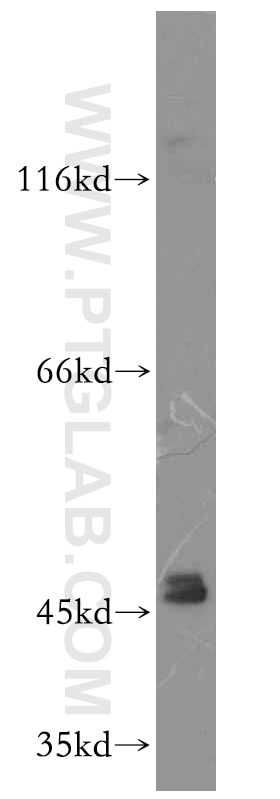
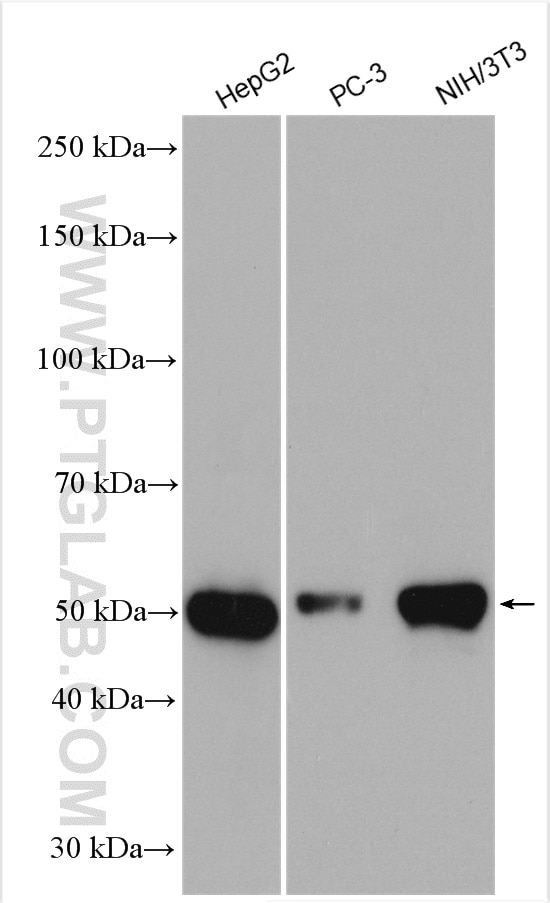
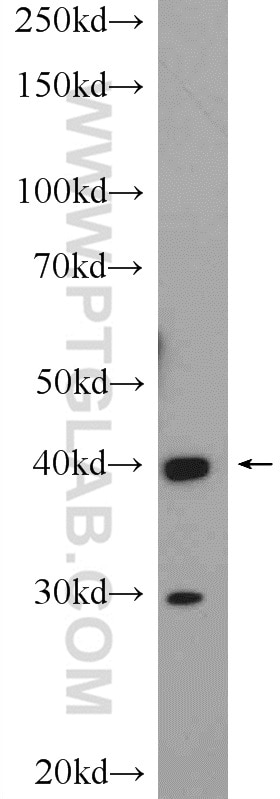
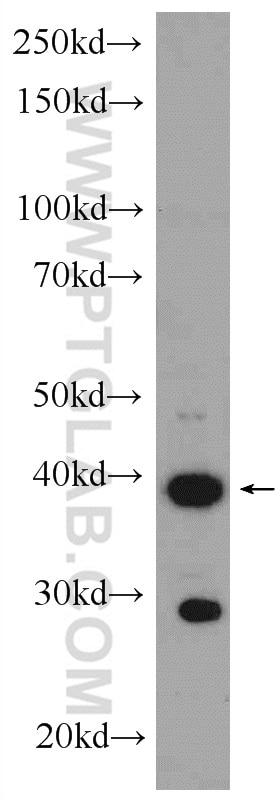
| Positive WB detected in | HepG2 cells, mouse liver tissue, mouse heart tissue, rat heart tissue, PC-3 cells, NIH/3T3 cells |
Recommended dilution
| Application | Dilution |
|---|---|
| Western Blot (WB) | WB : 1:1000-1:6000 |
| It is recommended that this reagent should be titrated in each testing system to obtain optimal results. | |
| Sample-dependent, Check data in validation data gallery. | |
Product Information
19530-1-AP targets GATA4-Specific in WB, IHC, IF, IP, CoIP, ChiP, ELISA applications and shows reactivity with human, mouse, rat samples.
| Tested Reactivity | human, mouse, rat |
| Cited Reactivity | human, mouse, rat, pig, monkey |
| Host / Isotype | Rabbit / IgG |
| Class | Polyclonal |
| Type | Antibody |
| Immunogen |
Peptide Predict reactive species |
| Full Name | GATA binding protein 4 |
| Calculated Molecular Weight | 45 kDa |
| Observed Molecular Weight | 45 kDa |
| GenBank Accession Number | NM_002052 |
| Gene Symbol | GATA4 |
| Gene ID (NCBI) | 2626 |
| RRID | AB_10642003 |
| Conjugate | Unconjugated |
| Form | Liquid |
| Purification Method | Antigen affinity purification |
| UNIPROT ID | P43694 |
| Storage Buffer | PBS with 0.02% sodium azide and 50% glycerol, pH 7.3. |
| Storage Conditions | Store at -20°C. Stable for one year after shipment. Aliquoting is unnecessary for -20oC storage. 20ul sizes contain 0.1% BSA. |
Background Information
What is the molecular weight of GATA4? Is GATA4 post-translationally modified?
The molecular weight of GATA4 is 48 kDa. GATA4 can be phosphorylated, which regulates its activity (PMID: 10788492).
What is the subcellular localization of GATA4?
GATA4 localizes to the nucleus. The nuclear localization motif is present in the C-terminal part of GATA4 (PMID: 9079680).
What is the tissue expression pattern of GATA4?
GATA4 was initially identified as a cardiac transcription factor important for the development of the heart and as one of the earliest transcription factors expressed in developing cardiac cells. However, GATA4 is expressed in numerous organs such as the liver, lung, gonads, and small intestine (PMID: 8455608).
Protocols
| Product Specific Protocols | |
|---|---|
| WB protocol for GATA4-Specific antibody 19530-1-AP | Download protocol |
| Standard Protocols | |
|---|---|
| Click here to view our Standard Protocols |
Publications
What published studies show
The anti-GATA4 antibody (Cat# 19530-1-AP) has 52 citations published across journals including Nature, Nature Communications, Molecular Cell, EMBO Journal, Genome Biology, Cell Death & Disease, Advanced Science, and PLoS ONE. Research fields span cardiac disease (hypertrophy, heart failure, myocardial infarction), cancer (pancreatic, ovarian, breast, nasopharyngeal), cellular senescence, stem cell differentiation, developmental biology, immunology, vascular biology, bone metabolism, and toxicology. Applications include WB, IF, IHC, CoIP, IP, and ChIP.
| Species | Application | Title |
|---|---|---|
Nat Commun Cell enlargement modulated by GATA4 and YAP instructs the senescence-associated secretory phenotype | ||
Nat Commun Regulation of senescence-associated secretory phenotypes in osteoarthritis by cytosolic UDP-GlcNAc retention and O-GlcNAcylation | ||
ACS Nano Silver Nanoparticles Compromise Female Embryonic Stem Cell Differentiation through Disturbing X Chromosome Inactivation. | ||
Mol Cell Histone chaperone HIRA, promyelocytic leukemia protein, and p62/SQSTM1 coordinate to regulate inflammation during cell senescence. | ||
J Exp Clin Cancer Res Overexpressed WDR3 induces the activation of Hippo pathway by interacting with GATA4 in pancreatic cancer. |


