
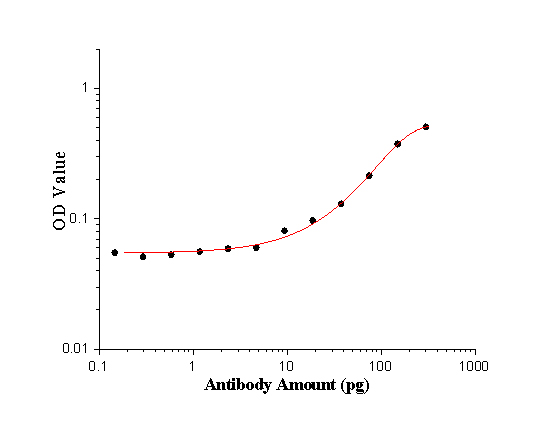

Tested Applications
| Positive ELISA detected in | peptide |
Recommended dilution
| Application | Dilution |
|---|---|
| Enzyme-linked Immunosorbent Assay (ELISA) | ELISA : 1:10-1:100 |
| It is recommended that this reagent should be titrated in each testing system to obtain optimal results. | |
| Sample-dependent, Check data in validation data gallery. | |
Product Information
24492-1-AP targets GA repeat in WB, IHC, IF, Dot Blot, ELISA applications and shows reactivity with human samples.
| Tested Reactivity | human |
| Cited Reactivity | human, mouse, drosophila |
| Host / Isotype | Rabbit / IgG |
| Class | Polyclonal |
| Type | Antibody |
| Immunogen |
Peptide Predict reactive species |
| Full Name | GA repeat |
| Gene Symbol | |
| Gene ID (NCBI) | |
| RRID | AB_2879571 |
| Conjugate | Unconjugated |
| Form | Liquid |
| Purification Method | Antigen affinity purification |
| Storage Buffer | PBS with 0.02% sodium azide and 50% glycerol, pH 7.3. |
| Storage Conditions | Store at -20°C. Stable for one year after shipment. Aliquoting is unnecessary for -20oC storage. 20ul sizes contain 0.1% BSA. |
Background Information
The C9orf72 "GGGGCC" repeat sequence codes five repeat peptide "GA repeat; GAGAGAGAGA", "GP repeat; GPGPGPGPG", "GR repeat; GRGRGRGRG", "AP repeat; APAPAPAPA" and "PR repeat; PRPRPRPRP". It was described previously that aggregated forms of poly-GA and poly-GP proteins do not enter the separation gel (PMID: 26374446). This antibody is used to detect the "GA repeat" sequence. This antibody detects the GAGAGAGAGA peptide with dilution 1:32,000 in Elisa.
Publications
What published studies show
Antibody 24492-1-AP (targeting C9orf72 dipeptide repeat proteins) has 20 total citations. These appear in journals including Cell, Nature Neuroscience, Neuron, Journal of Clinical Investigation, EMBO Molecular Medicine, Cell Reports, Molecular Neurobiology, Stem Cells, Experimental Neurology, Journal of Biological Chemistry, Journal of Cell Science, Human Molecular Genetics, Life Science Alliance, Neuropathology and Applied Neurobiology, International Journal of Molecular Sciences, and bioRxiv. Research fields center on ALS/FTD neurodegeneration, C9orf72 repeat-associated toxicity, and RNA-mediated disease mechanisms.
| Species | Application | Title |
|---|---|---|
Nat Neurosci Human ALS/FTD brain organoid slice cultures display distinct early astrocyte and targetable neuronal pathology. | ||
Neuron Disruption of nuclear speckle integrity dysregulates RNA splicing in C9ORF72-FTD/ALS | ||
J Clin Invest CRISPR-Cas13d targeting suppresses repeat-associated non-AUG translation of C9orf72 hexanucleotide repeat RNA | ||
EMBO Mol Med Active poly-GA vaccination prevents microglia activation and motor deficits in a C9orf72 mouse model. | ||
Cell Rep Altered MICOS Morphology and Mitochondrial Ion Homeostasis Contribute to Poly(GR) Toxicity Associated with C9-ALS/FTD. |


