

Tested Applications
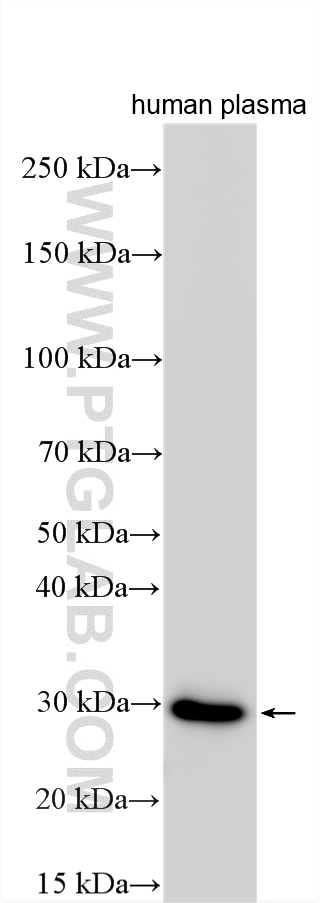
| Positive WB detected in | human plasma |
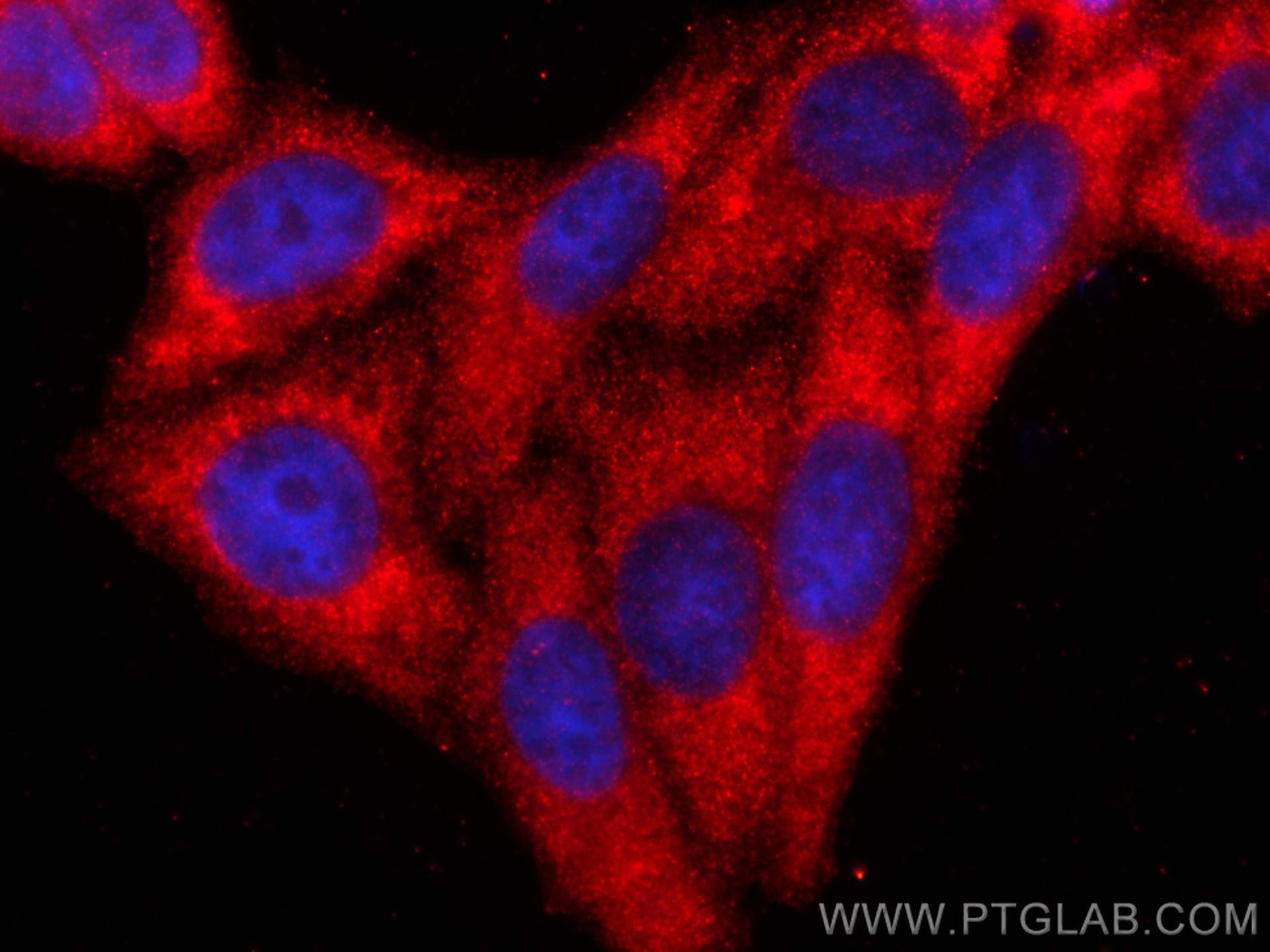
| Positive IF/ICC detected in | HepG2 cells |
Recommended dilution
| Application | Dilution |
|---|---|
| Western Blot (WB) | WB : 1:1000-1:8000 |
| Immunofluorescence (IF)/ICC | IF/ICC : 1:50-1:500 |
| It is recommended that this reagent should be titrated in each testing system to obtain optimal results. | |
| Sample-dependent, Check data in validation data gallery. | |
Product Information
11602-1-AP targets C1QA in WB, IHC, IF/ICC, ELISA applications and shows reactivity with human samples.
| Tested Reactivity | human |
| Cited Reactivity | human |
| Host / Isotype | Rabbit / IgG |
| Class | Polyclonal |
| Type | Antibody |
| Immunogen |
CatNo: Ag2141 Product name: Recombinant human C1QA protein Source: e coli.-derived, PGEX-4T Tag: GST Domain: 1-245 aa of BC030153 Sequence: MEGPRGWLVLCVLAISLASMVTEDLCRAPDGKKGEAGRPGRRGRPGLKGEQGEPGAPGIRTGIQGLKGDQGEPGPSGNPGKVGYPGPSGPLGARGIPGIKGTKGSPGNIKDQPRPAFSAIRRNPPMGGNVVIFDTVITNQEEPYQNHSGRFVCTVPGYYYFTFQVLSQWEICLSIVSSSRGQVRRSLGFCDTTNKGLFQVVSGGMVLQLQQGDQVWVEKDPKKGHIYQGSEADSVFSGFLIFPSA Predict reactive species |
| Full Name | complement component 1, q subcomponent, A chain |
| Calculated Molecular Weight | 245 aa, 26 kDa |
| Observed Molecular Weight | 26-30 kDa |
| GenBank Accession Number | BC030153 |
| Gene Symbol | C1QA |
| Gene ID (NCBI) | 712 |
| RRID | AB_2067153 |
| Conjugate | Unconjugated |
| Form | Liquid |
| Purification Method | Antigen affinity purification |
| UNIPROT ID | P02745 |
| Storage Buffer | PBS with 0.02% sodium azide and 50% glycerol, pH 7.3. |
| Storage Conditions | Store at -20°C. Stable for one year after shipment. Aliquoting is unnecessary for -20oC storage. 20ul sizes contain 0.1% BSA. |
Background Information
The first component of complement, C1, is a calcium-dependent complex of the 3 subcomponents C1q, C1r, and C1s. C1q is composed of 18 polypeptide chains: six A-chains, six B-chains, and six C-chains. Each chain contains a collagen-like region located near the N terminus and a C-terminal globular region. Deficiency of C1q has been associated with lupus erythematosus and glomerulonephritis. This antibody is raised against C1qA which is the A-chain polypeptide of human complement subcomponent C1q.
Protocols
| Product Specific Protocols | |
|---|---|
| IF protocol for C1QA antibody 11602-1-AP | Download protocol |
| WB protocol for C1QA antibody 11602-1-AP | Download protocol |
| Standard Protocols | |
|---|---|
| Click here to view our Standard Protocols |
Publications
What published studies show
The C1QA Polyclonal antibody (Cat# 11602-1-AP) has accumulated 27 citations in high-impact journals including Nature, Nature Neuroscience, Nature Communications, Neuron, Alzheimer's & Dementia, Molecular Therapy, Brain, Behavior, and Immunity, JCI Insight, and PLoS Genetics. Associated research fields encompass neurodegeneration (Alzheimer's disease, Parkinson's disease, frontotemporal dementia), microglial activation and synaptic pruning, complement-mediated immunity, epilepsy, sepsis, cancer biology, cardiovascular disease, and renal pathology.
| Species | Application | Title |
|---|---|---|
Nat Neurosci The mitochondrial unfolded protein response in human microglia disrupts neuronal-glial communication and promotes senescence. | ||
Nat Neurosci GABA-dependent microglial elimination of inhibitory synapses underlies neuronal hyperexcitability in epilepsy | ||
Nat Commun A RANKL-UCHL1-sCD13 negative feedback loop limits osteoclastogenesis in subchondral bone to prevent osteoarthritis progression | ||
Nat Commun Small intestinal γδ T17 cells promote SAE through STING/C1q-induced microglial synaptic pruning in male mice | ||
Neuron TREM2-independent microgliosis promotes tau-mediated neurodegeneration in the presence of ApoE4 |
Reviews
What customers say
The product has one user review. Alicia Lam rated it 3 out of 5 stars after using it at a 1:1000 dilution for immunofluorescence on cortical organoids derived from iPSC controls (lot 00021206). Her brief comment noted the application context but did not elaborate on performance details or provide specific feedback on staining quality or specificity.
The reviews below have been submitted by verified Proteintech customers who received an incentive for providing their feedback.
Alicia (Verified Customer) (10-07-2025) | Cortical organoid
|

